

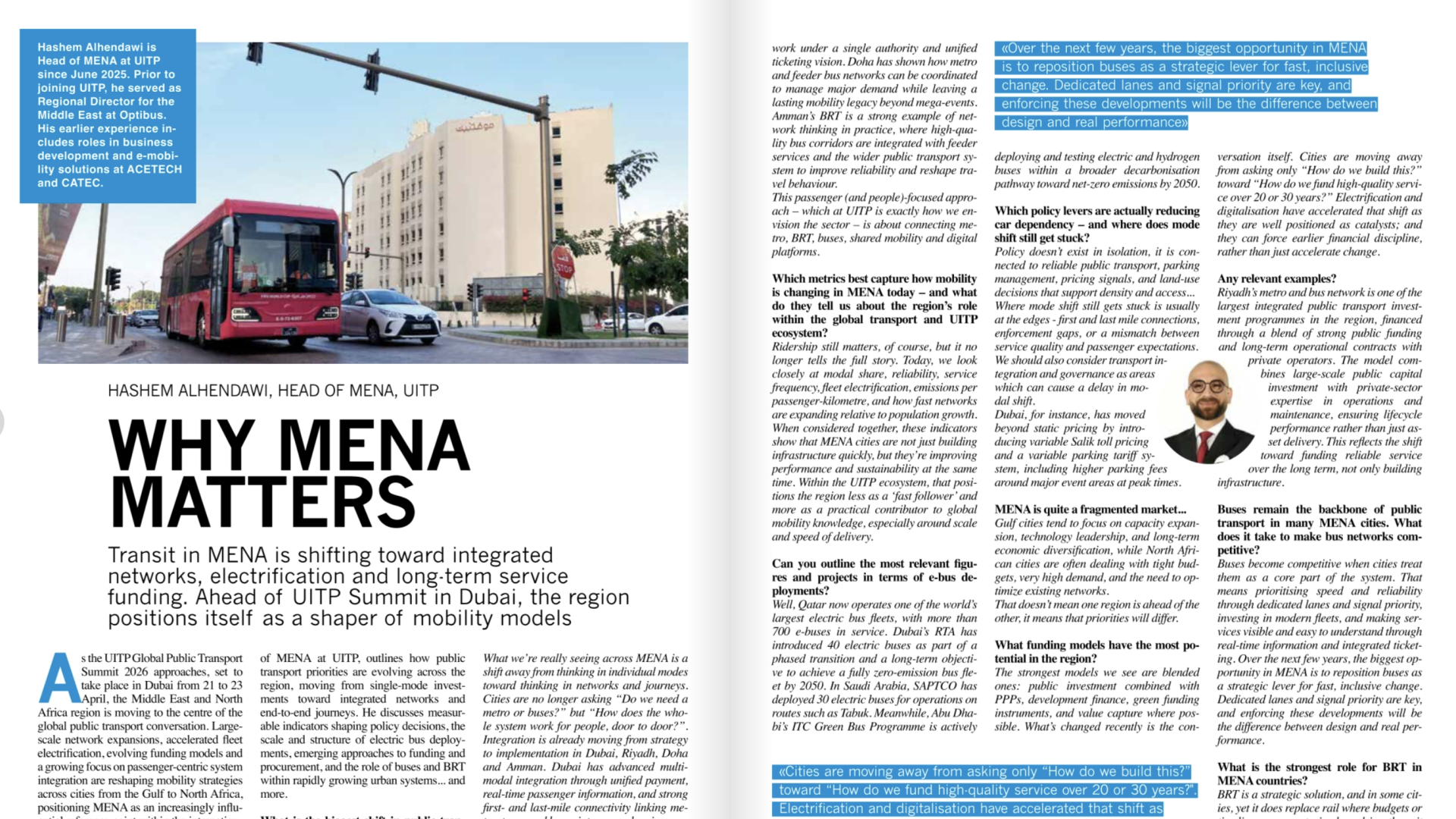
Because the UITP International Public Transport Summit 2026 was initially scheduled to happen in Dubai from 21 to 23 April, the Center East and North Africa area was getting ready to be positioned on the centre of the worldwide public transport agenda. Massive-scale community expansions, accelerated fleet electrification, evolving funding fashions and a rising concentrate on passenger-centric system integration proceed to form mobility methods throughout cities from the Gulf to North Africa.
This interview was printed on Sustainable Bus journal concern out in February 2026. All our journal points can be found on-line HERE
Within the following alternate, Alhendawi outlines how public transport priorities are evolving throughout the area, transferring from single-mode investments towards built-in networks and end-to-end journeys, whereas additionally addressing the continuity of regional and world cooperation within the absence of the Summit.
With the UITP Summit 2026 in Dubai now not happening, what are the following steps for sustaining worldwide dialogue within the area? What different codecs or initiatives are being thought-about to keep up continuity in regional and world dialogue?
Cancelling the Summit was definitely not a simple resolution, but it surely was the accountable one, guided by our people-first strategy and obligation of care to delegates, members, and employees. It is very important emphasise that worldwide dialogue in public transport doesn’t depend upon a single occasion, it’s steady and constructed on long-term partnerships and ongoing collaboration.
More Read

UITP MENA stays absolutely dedicated to supporting engagement throughout the area and globally, and we’re working intently with our members and stakeholders to make sure that conversations, information alternate, and cooperation proceed with out interruption.
The MENA area continues to play an essential function within the world mobility panorama, and sustaining sturdy worldwide connections is important.
Over the following few years, the most important alternative in MENA is to reposition buses as a strategic lever for quick, inclusive change. Devoted lanes and sign precedence are key, and imposing these developments would be the distinction between design and actual efficiency.
More Read

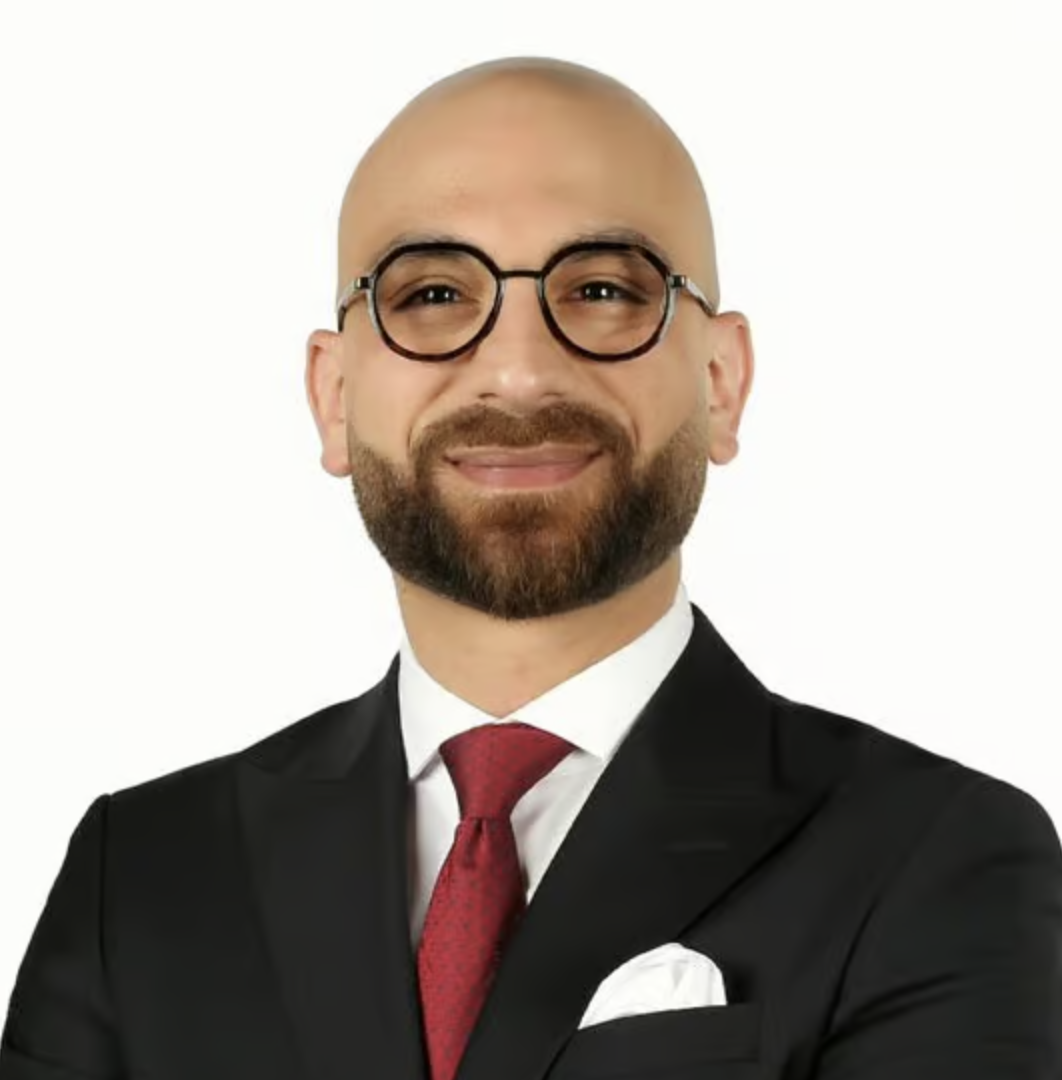
Hashem Alhendawi, Head of MENA, UITP
Hashem Alhendawi: transit shift in MENA area
What’s the greatest shift in public transport throughout MENA proper now – and what’s driving it most?
What we’re actually seeing throughout MENA is a shift away from pondering in particular person modes towards pondering in networks and journeys. Cities are now not asking “Do we need a metro or buses?” however “How does the whole system work for people, door to door?”. Good examples may be seen in Dubai, Riyadh, Doha, and Amman, the place integration is already transferring from technique to implementation.
Dubai has superior multimodal integration by unified cost, real-time passenger info, and powerful first- and last-mile connectivity linking metro, tram, and buses right into a seamless journey. Riyadh is constructing towards full integration with its new metro and redesigned bus community underneath a single authority and unified ticketing imaginative and prescient. Doha has proven how metro and feeder bus networks may be coordinated to handle main demand whereas leaving an enduring mobility legacy past mega-events.
More Read

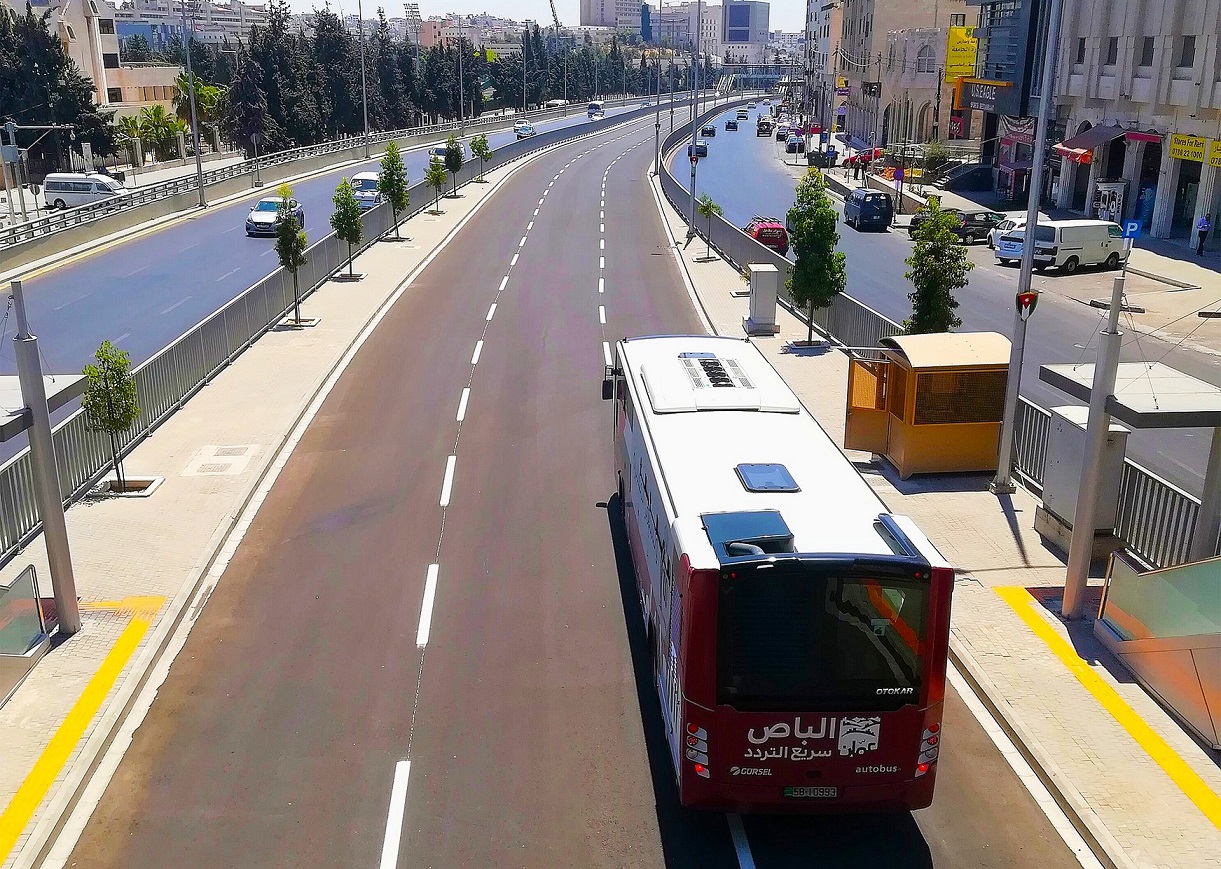
Amman’s BRT is a robust instance of community pondering in observe, the place high-quality bus corridors are built-in with feeder companies and the broader public transport system to enhance reliability and reshape journey behaviour.
This passenger (and other people)-focused strategy – which at UITP is precisely how we envision the sector – is about connecting metro, BRT, buses, shared mobility and digital platforms.
This passenger-centric focus is pushed by quick city development, local weather commitments, and a really clear actuality: public transport needs to be a real different to the non-public automotive. In MENA we now have a robust presence of zero-emission fleets throughout bus networks which is contributing effectively to lowering emissions.
You talked about e-bus fleets, are you able to define some related key research and tasks?
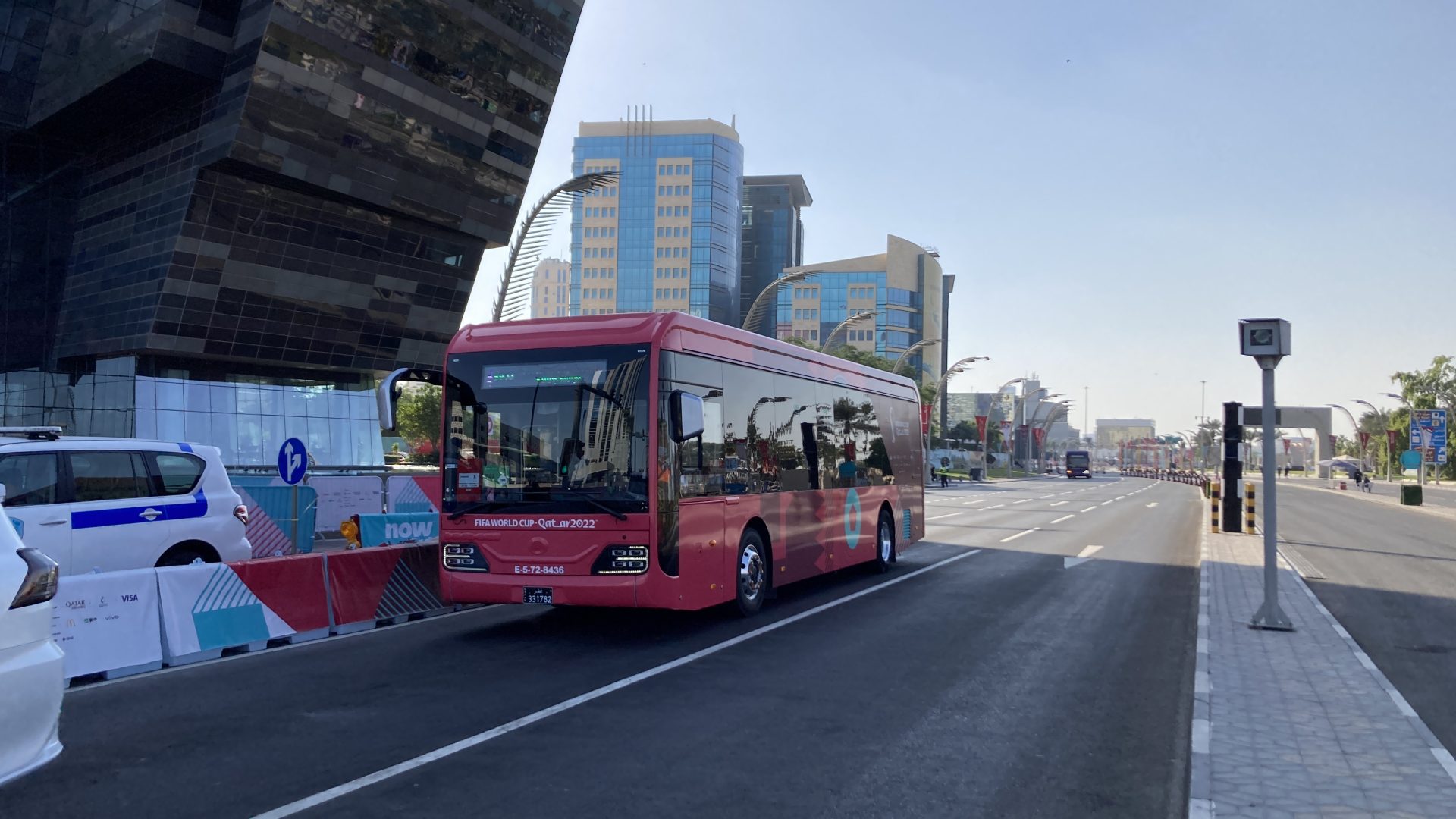
As an illustration, Qatar now operates one of many world’s largest electrical bus fleets, with greater than 700 e-buses in service. Dubai’s RTA has launched 40 electrical buses as a part of a phased transition and a long-term goal to realize a completely zero-emission bus fleet by 2050. In Saudi Arabia, SAPTCO has deployed 30 electrical buses for operations on routes comparable to Tabuk. In the meantime, Abu Dhabi’s ITC Inexperienced Bus Programme is actively deploying and testing electrical and hydrogen buses inside a broader decarbonisation pathway towards net-zero emissions by 2050.
Which metrics greatest seize how mobility is altering in MENA in the present day – and what do they inform us in regards to the area’s function inside the world transport / UITP ecosystem?
Ridership nonetheless issues, after all, but it surely now not tells the complete story. At this time, we glance intently at modal share, reliability, service frequency, fleet electrification, emissions per passenger-kilometre, and how briskly networks are increasing relative to inhabitants development.
When thought-about collectively, these indicators present that MENA cities aren’t simply constructing infrastructure shortly, however they’re enhancing efficiency and sustainability on the similar time. Throughout the UITP ecosystem, that positions the area much less as a ‘fast follower’ and extra as a sensible contributor to world mobility information, particularly round scale and pace of supply.
Automotive dependency, potential, public curiosity
Which coverage levers are literally lowering automotive dependency – and the place does mode shift nonetheless get caught?
The place we see actual progress occurring, it’s extra a couple of mixture of things. Coverage doesn’t exist in isolation, it’s linked to dependable public transport, parking administration, pricing indicators, and land-use choices that help density and entry…
The place mode shift nonetheless will get caught is often on the edges – first and final mile connections, enforcement gaps, or a mismatch between service high quality and passenger expectations. We must also think about transport integration and governance as areas which might trigger a delay in modal shift.
Dubai, for example, has moved past static pricing by introducing variable Salik toll pricing and a variable parking tariff system, together with increased parking charges round main occasion areas at peak occasions.
MENA is sort of a fragmented market: what are the important thing variations between the Gulf and North Africa?
Gulf cities are inclined to concentrate on capability growth, know-how management, and long-term financial diversification, whereas North African cities are sometimes coping with tight budgets, very excessive demand, and the necessity to optimize current networks.
That doesn’t imply one area is forward of the opposite, it signifies that priorities will differ.
Cities are transferring away from asking solely “How do we build this?” towards “How do we fund high-quality service over 20 or 30 years?”. Electrification and digitalisation have accelerated that shift as they’re effectively positioned as catalysts; and so they can power earlier monetary self-discipline, moderately than simply speed up change
Hashem Alhendawi, Head of MENA, UITP
What funding fashions have essentially the most potential within the area?
The strongest fashions we see are blended ones: public funding mixed with PPPs, growth finance, inexperienced funding devices, and worth seize the place attainable.
What’s modified just lately is the dialog itself. Cities are transferring away from asking solely “How do we build this?” towards “How do we fund high-quality service over 20 or 30 years?” Electrification and digitalisation have accelerated that shift, and it’s a theme we hear repeatedly throughout UITP MENA discussions. Electrification and digitalisation are effectively positioned as catalysts; and so they can power earlier monetary self-discipline, moderately than simply speed up change.
Riyadh’s metro and bus community is among the largest built-in public transport funding programmes within the area, financed by a mix of sturdy public funding and long-term operational contracts with non-public operators. The mannequin combines large-scale public capital funding with private-sector experience in operations and upkeep, guaranteeing lifecycle efficiency moderately than simply asset supply. This displays the shift towards funding dependable service over the long run, not solely constructing infrastructure.
As private and non-private mobility companies blur, how ought to authorities regulate platforms whereas defending the general public curiosity?
The secret’s actually about integration. Authorities want to make sure that platforms complement public transport moderately than fragment it. Meaning clear frameworks round information sharing, security, fare coverage, and repair protection.
Probably the most profitable approaches we see are literally hybrid ones: sturdy public oversight mixed with room for personal innovation.
Buses are spine of public transport in MENA
Buses stay the spine of public transport in lots of MENA cities. What does it take to make bus networks aggressive?
Buses change into aggressive when cities deal with them as a core a part of the system. Meaning prioritising pace and reliability by devoted lanes and sign precedence, investing in fashionable fleets, and making companies seen and straightforward to grasp by real-time info and built-in ticketing.
Over the following few years, the most important alternative in MENA is to reposition buses as a strategic lever for quick, inclusive change. Devoted lanes and sign precedence are key, and imposing these developments would be the distinction between design and actual efficiency.
We count on autonomy to develop alongside two tracks: robotaxi-style companies in versatile or lower-density contexts, and driverless know-how built-in into public transport on high-capacity corridors. Governance ought to stay firmly anchored in public authorities, even when non-public platforms are concerned.
Hashem Alhendawi, Head of MENA, UITP
What’s the strongest function for BRT in MENA nations?
BRT is a strategic resolution, and in some cities, but it does change rail the place budgets or timelines are constrained; and in others it feeds metro programs or operates as a long-term trunk hall. Nevertheless it additionally has a strategic function to play in its personal proper.
The deciding issue is high quality of design. When BRT is deliberate with future capability in thoughts, it turns into a everlasting asset. Cities like Amman have performed an essential function in shaping how BRT is perceived throughout the area.
Chinese language OEMs and electrical buses: world procurement or native partnerships?
Probably the most resilient strategy sits within the center. Cities profit from world procurement to entry innovation, however long-term success will depend on native capability, on meeting, upkeep, expertise, and provide chains.
That’s why we more and more see cities favour long-term partnerships moderately than one-off purchases. A robust instance is Qatar’s large-scale e-bus deployment, the place Chinese language producer Yutong provided over 700 electrical buses, whereas charging infrastructure and depot programs had been delivered by worldwide companions comparable to ABB. This exhibits how cities mix world car suppliers with specialised infrastructure suppliers, transferring past one-off procurement towards built-in supply fashions. It’s a stability between openness and strategic autonomy, and it’s a dialog occurring throughout the area.
Dubai’s autonomy goal: robotaxis or public transport – and underneath whose governance?
In actuality, it’s not an both or query. We count on autonomy to develop alongside two tracks: robotaxi-style companies in versatile or lower-density contexts, and driverless know-how built-in into public transport on high-capacity corridors.
Governance ought to stay firmly anchored in public authorities, even when non-public platforms are concerned. Dubai’s ambition makes it a useful reference level for the area as these fashions evolve.
How does UITP plan to assist cities preserve this management towards world tech giants?
UITP’s place as the one world affiliation to deliver collectively all sector gamers places us and our members within the distinctive place of having the ability to help cities by offering coverage frameworks, peer studying, and sensible steering. By bringing specialists across the desk, we will collaborate to assist information public authorities to raised outline information, security, and accountability guidelines early, guaranteeing governance stays firmly in public fingers when participating with world know-how suppliers.
To what extent can Dubai be seen as a laboratory for future mobility?
Dubai is uniquely positioned due to its regulatory agility, monetary capability, and willingness to check concepts at scale. That makes it an efficient laboratory, but additionally a reminder that not all the things is instantly transferable. Dubai assessments each know-how and governance fashions, not solely innovation, and the true worth lies in experimentation, transparency, and sharing outcomes.
That’s the place world platforms like UITP play an important function: turning pilots into classes that others can adapt.
What legacy has Qatar’s 2022 e-bus deployment created?
Qatar confirmed how mega-events can speed up know-how adoption, which has been spectacular. The lasting affect comes from operational requirements, workforce coaching, and system integration. Via good organisation and powerful operations, Qatar’s legacy is robust.
The important thing lesson is de facto centred round prepardness and likewise continuity. Expertise solely delivers worth when it’s embedded into long-term operations, and that perception continues to affect pondering throughout the area.
Editor’s Word: That is an up to date model of the unique information article. The preliminary model was printed at: https://www.sustainable-bus.com/information/hashem-alhendawi-mena-public-transport-trends/.