

Key insights
Social media use within the Center East and North Africa is among the many highest on the earth, though appreciable variations seem amongst international locations. Heavy use is extra frequent than in different areas: between 20% and 40% of customers reported greater than 5 hours of use in 2023–2024.
Social media use is heavier amongst sure social teams. Gen Z, males, single people, much less spiritual and extra prosperous respondents, in addition to these with greater schooling, are more likely to be heavy customers.
On common, heavy social media use (greater than 5 hours per day) is related to decrease wellbeing. Heavy customers are considerably extra prone to report greater stress and depressive signs, and imagine they’re worse off than their dad and mom, in contrast with non- or average customers.
Introduction
More Read
Though social media use within the Center East and North Africa (MENA) is among the many highest globally, particularly amongst younger individuals, analysis on the connection between social media use and wellbeing within the area has acquired comparatively much less consideration. As in different world areas, social media performs a number of roles in MENA, the place it serves as a platform for leisure, commerce, private expression, facilitating social connections and id formation, and offering entry to data past conventional media channels. What distinguishes the MENA area from Western international locations isn’t a lot the platforms themselves because the cultural and political landscapes by which they function. Right here, social media use unfolds inside societies that place sturdy emphasis on household ties, neighborhood norms, and collective id, and inside political environments which will contain various levels of surveillance, regulation, and restrictions on digital visibility. These options can affect why and the way individuals interact with social media, in addition to the psychological and social penalties that observe.
This underexplored context stands in distinction to the broader analysis panorama, the place most research on the connection between social media use and wellbeing have been carried out in Western, high-income settings, together with america, Canada, the UK, and Western Europe. Though invaluable, these insights can’t be generalised. Cultural values, social norms, and patterns of expertise adoption differ throughout societies, influencing each the usage of social media and its penalties for wellbeing. Lately, research on East Asia have begun to broaden the proof base, however different world areas have acquired comparatively much less consideration. On this chapter, we concentrate on social media use within the MENA area and look at its relationship with wellbeing on this a part of the world.
We doc that the connection between social media use and wellbeing within the MENA area isn’t uniformly optimistic or unfavourable, however reasonably is determined by how platforms are used and the context by which digital life unfolds. The interaction between alternatives for connection and expression on the one hand, and dangers related to social pressures and publicity to dangerous or restrictive content material on the opposite, shapes the connection between social media use and wellbeing within the area. The outcomes counsel substantial similarities between the MENA area and Western societies.
More Read

We start by inspecting how individuals within the MENA area utilise social media, the period of time they spend on-line, and which platforms they like. We then flip to what this implies for his or her wellbeing. We concentrate on three measures of wellbeing: stress, depressive signs, and perceived life high quality in comparison with dad and mom. Thereafter, we think about whether or not these associations differ by platform, distinguishing between social networking websites, media-sharing apps resembling Instagram and TikTok, and messaging providers. Lastly, we look at the position of influencers and the way this factor moderates the connection between social media use and wellbeing.
Social media use in MENA is among the many highest on the earth. GWI’s 2024 report on world social media developments signifies that, on common, social media customers within the MENA area spend roughly three hours per day on social media, which is above the worldwide common. Gallup World Ballot knowledge from 2022 present that social media use over the previous three months averages 74% in MENA international locations, in comparison with 76% in Europe and North America, Australia, and New Zealand (NANZ), and 57% in the remainder of the world. On the identical time, there are appreciable variations between international locations inside the MENA area. In all surveyed Gulf Cooperation Council (GCC) international locations, social media use exceeds 80%, whereas in a number of international locations in North Africa (Egypt, Mauritania, and Yemen), it’s effectively beneath 60%.
Social media use in MENA is among the many highest on the earth.
Within the the rest of this chapter, we primarily draw on knowledge from the Arab Barometer, which incorporates the next query on self-reported social media use: “How many hours on a typical day do you spend on social media platforms?” Response classes have been: (1) under no circumstances, (2) as much as 2 hours, (3) as much as 5 hours, (4) as much as 10 hours, and (5) 10 hours or extra. All through the chapter, we distinguish between non-users, average customers (these reporting as much as 2 or as much as 5 hours per day), and heavy customers (these reporting as much as 10 hours or 10 hours or extra per day). According to proof from the Gallup World Ballot, the Arab Barometer knowledge proven in Determine 9.1 point out that social media use is widespread throughout MENA. In most international locations, greater than 80% of respondents reported utilizing social media in 2023–2024, a share that has elevated over latest years. Heavy use, outlined as greater than 5 hours per day, now usually ranges between 20% and 40% of the grownup inhabitants, various from round 15% in Morocco to roughly 45% in Lebanon. General, the proportion of people spending greater than 5 hours per day on social media has risen over time. In international locations for which three survey waves can be found, we observe a gradual enhance within the share of heavy customers, with the notable exception of Morocco. Most notably, in Lebanon, the proportion of heavy customers went from 22% in 2018–2019 to 45% in 2023–2024, whereas in Iraq, this determine elevated from 12% in 2018–2019 to 27% in 2023–2024.
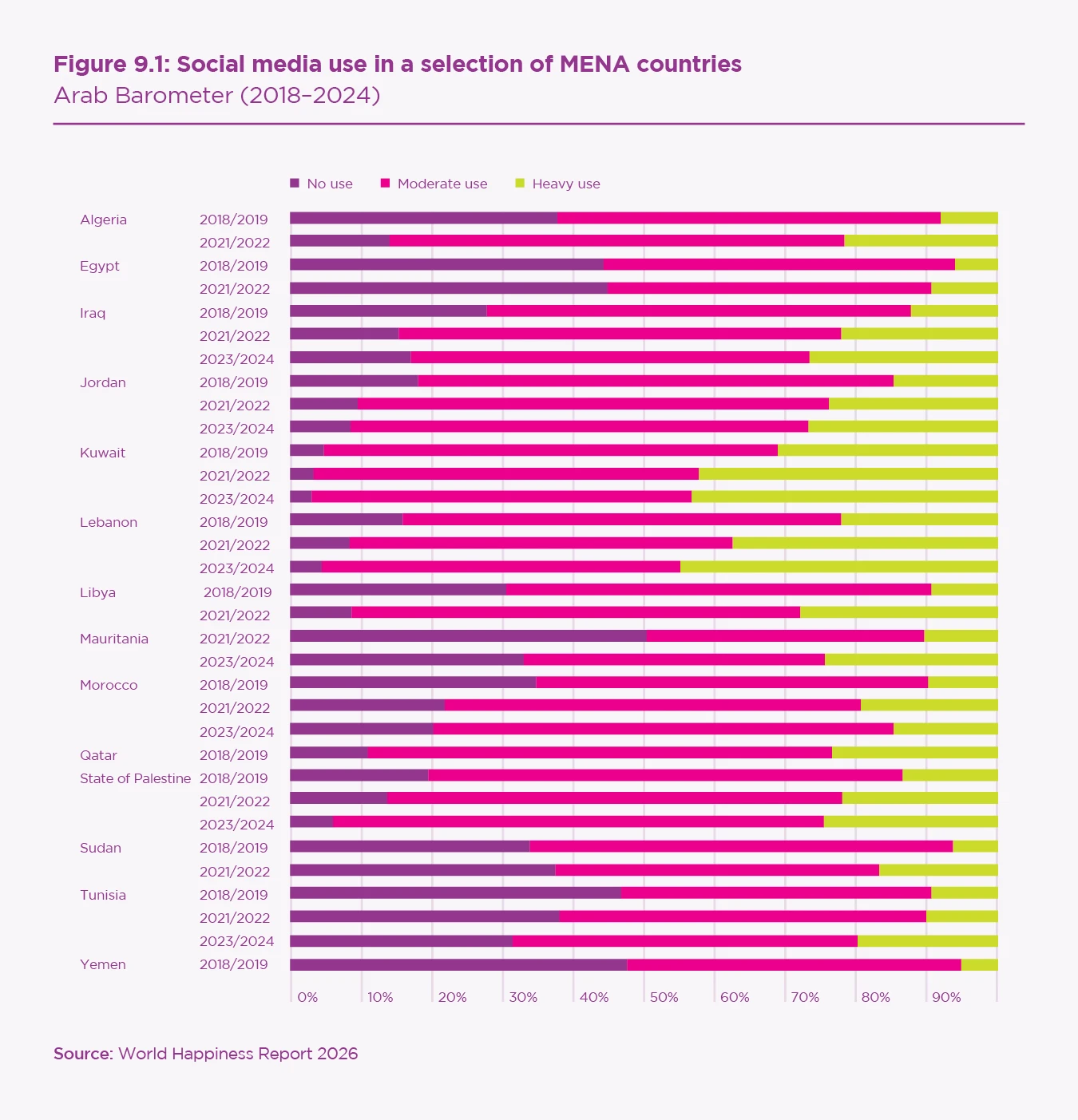 Determine 9.1: Social media use in a choice of MENA international locations. Arab Barometer (2018–2024)
More Read

Patterns of social media use differ considerably throughout social teams inside international locations (see Determine 9.2). Non-use is especially frequent amongst older generations, with almost 60% reporting no social media use. General, social media use is extra prevalent amongst males (80%) than girls (73%), and fewer frequent amongst married people (73%) than amongst those that are single or have by no means been married (92%). Utilization charges are additionally comparatively low amongst extra spiritual people, these with solely an elementary schooling (40%), and other people experiencing important monetary difficulties (66%). Heavy social media use (outlined as greater than 5 hours per day) is concentrated amongst youthful cohorts. Most notably, 38% of Era Z (born 1997–2012) report spending greater than 5 hours per day on social media. Heavy use can be extra frequent amongst non-Muslims (33%) and amongst people who’re single or have by no means been married (34%).
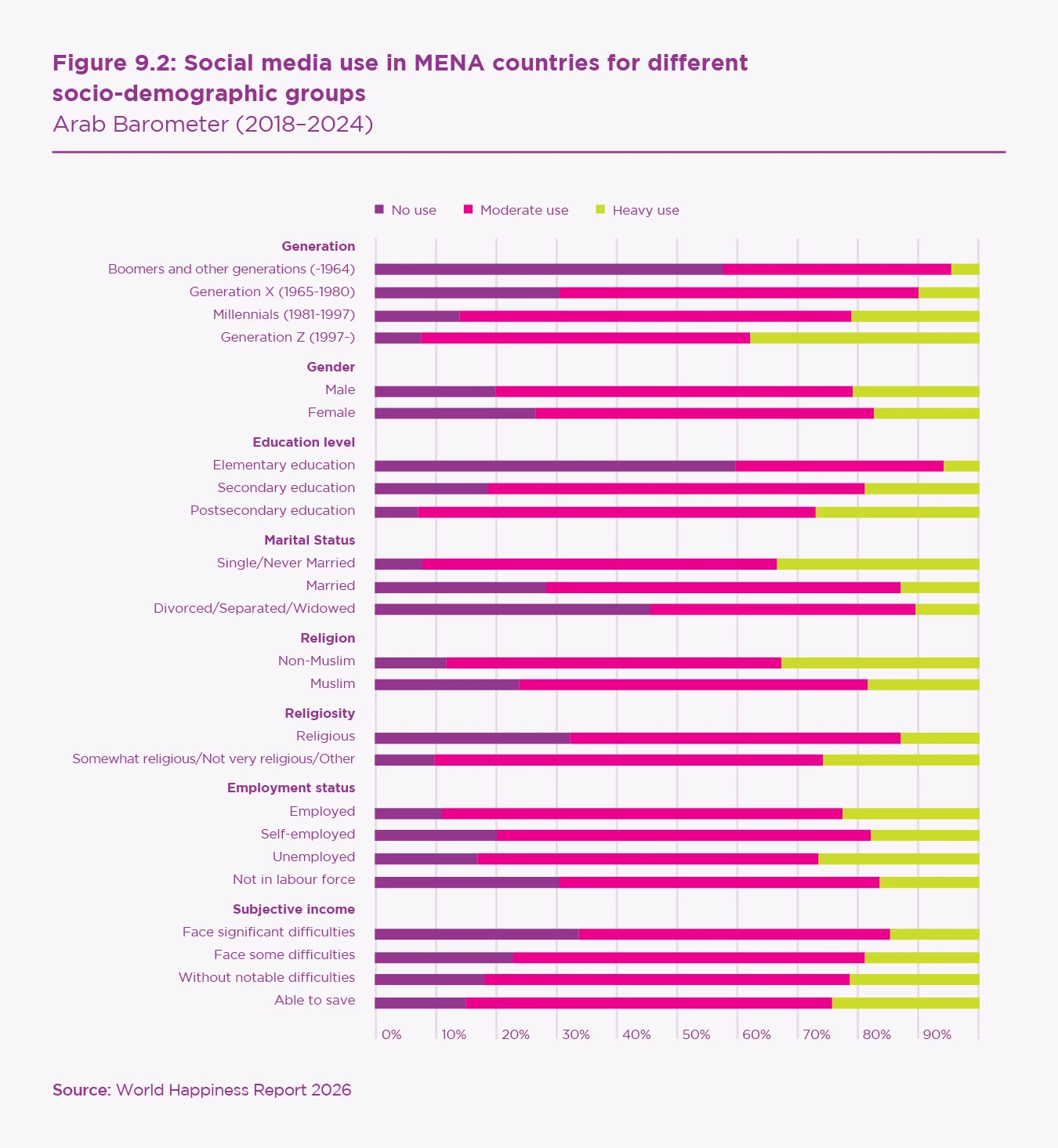 Determine 9.2: Social media use in MENA international locations for various socio-demographic teams Arab Barometer (2018–2024)
These findings echo the outcomes from the survey on social media use by Borges-Rey and colleagues, based mostly on over 7,300 phone interviews in seven Arab nations (Egypt, Jordan, Lebanon, Qatar, Saudi Arabia, Tunisia, and the United Arab Emirates), in addition to a latest survey of the literature on the MENA area by Abbouyi and colleagues. On the identical time, these students warning that the literature on heavy or problematic social media use within the MENA area is scarce, emphasising the necessity for extra analysis within the area.
Within the MENA context particularly, gendered norms surrounding on-line visibility, heightened concern of social disapproval, and decrease perceived usefulness of social media could discourage girls’s participation.
The decrease adoption of social media by girls within the MENA area may be partly attributed to region-specific social constraints, alongside mechanisms that function extra broadly throughout international locations. Within the MENA context particularly, gendered norms surrounding on-line visibility, heightened concern of social disapproval, and decrease perceived usefulness of social media could discourage girls’s participation. Prior analysis reveals that ladies in a number of MENA international locations face disproportionate dangers of on-line harassment and household surveillance, typically embedded in wider methods of social management and reputational issues. These context-specific dangers enhance the perceived social prices of social media use and might subsequently cut back adoption.
In contrast, the affiliation between marital standing and social media use displays extra common mechanisms noticed throughout international locations, resembling variations in obtainable free time, social networking motivations, and household obligations, although their relative significance could differ throughout cultural contexts. Though respondents who think about themselves spiritual are much less doubtless to make use of social media, it’s value noting that social media is more and more getting used as an area for spiritual engagement by influencers. Affluence and schooling are generally related to social media use, reflecting larger entry to digital applied sciences, larger perceived usefulness of social media, and systematic variations in utilization patterns (e.g., larger emphasis on informational and academic makes use of).
People in MENA international locations use quite a lot of social media platforms. In comparison with Western nations, older networks stay related in a big a part of the MENA area, though the usage of Fb has been declining just lately. Probably the most extensively used platforms within the interval 2018–2024 are Fb (60%) and WhatsApp (51%), adopted by YouTube, Instagram, and TikTok (see Determine 9.3). Nevertheless, there are some regional variations, with X (Twitter) and Snapchat being extra extensively used within the GCC international locations.
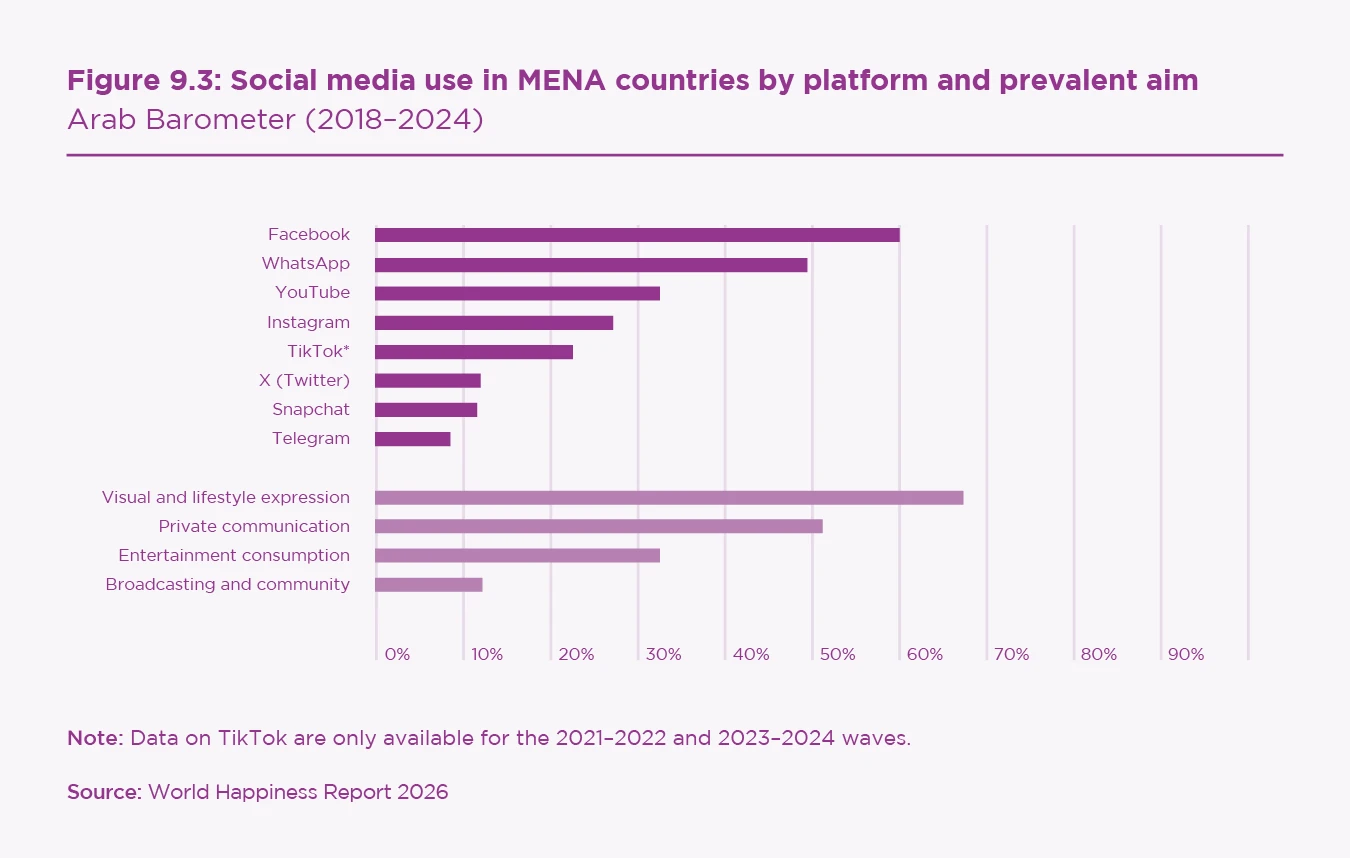 Determine 9.3: Social media use in MENA international locations by platform and prevalent intention Arab Barometer (2018–2024). Be aware: Information on TikTok are solely obtainable for the 2021–2022 and 2023–2024 waves.Field 9.1: Information and foremost variables within the Arab Barometer
Our evaluation predominantly attracts on survey knowledge from the Arab Barometer. We use three waves: wave 5 (2018–2019), wave 7 (2021–2022), and wave 8 (2023–2024). Sadly, not all MENA international locations and never all variables are constantly included within the three waves. Under, we talk about the principle variables used within the analyses. An summary of the international locations included within the evaluation is offered within the on-line appendix.
Social media use: We distinguish three teams of social media customers based mostly on their every day utilization time: (1) non-users, (2) average customers, and (3) heavy customers. Non-users both don’t use the web in any respect or report that they don’t interact with social media platforms. Reasonable customers report spending as much as 5 hours per day on social media. Heavy customers report spending greater than 5 hours per day on social media platforms. We offer empirical help for this taxonomy in endnote 3 and the evaluation beneath.
Sort of social media platforms: We distinguish between varied forms of social media platforms based mostly on their prevalent use within the MENA area. The classification relies on the survey run by Northwestern College in Qatar in 2021–2022, and distinguishes the next makes use of: (1) visible and way of life expression: Fb, Instagram, BeReal, TikTok, Snapchat, (2) personal communication platforms: WhatsApp, Telegram, Viber, and Sign, (3) public broadcasting and neighborhood participation: X (Twitter), Mastodon, Reddit, and Clubhouse, and (4) leisure consumption: YouTube.
Depressive signs are measured based mostly on the query: “Life is overwhelming at times. In the past six months, how often did you feel so depressed that nothing could cheer you up?” Reply classes have been (1) by no means, (2) generally, (3) typically, and (4) more often than not. This query is just obtainable within the 2018–2019 wave of the Arab Barometer.
Stress relies on the query: “In the past six months, how often did you feel so stressed that everything seemed to be a hassle?” Reply classes have been (1) by no means, (2) generally, (3) typically, and (4) more often than not. The solutions to this query are solely obtainable within the 2018–2019 wave of the Arab Barometer.
Life high quality in comparison with one’s personal dad and mom is measured by the query: “Do you believe that the quality of your life is better, the same as, or worse than the quality of your parents’ lives?” Reply classes have been (1) higher, (2) the identical, and (3) worse. This query was requested within the 2021–2022 and 2023–2024 waves of the Arab Barometer.
General, heavy social media customers undertake all forms of platforms to an awesome extent. In comparison with average customers, heavy customers are 1.4 occasions extra doubtless to make use of social media for personal communication, 2.3 occasions extra doubtless to make use of social media for visible and way of life expression, 1.9 occasions extra doubtless to make use of social media for public broadcasting and neighborhood engagement, and 1.7 occasions extra doubtless to make use of social media for leisure consumption. Most social media customers use a number of forms of platforms (see Determine 9.4), however heavy customers stand out. Amongst those that use just one platform, the prevalent intention is both personal communication or visible and way of life expression.
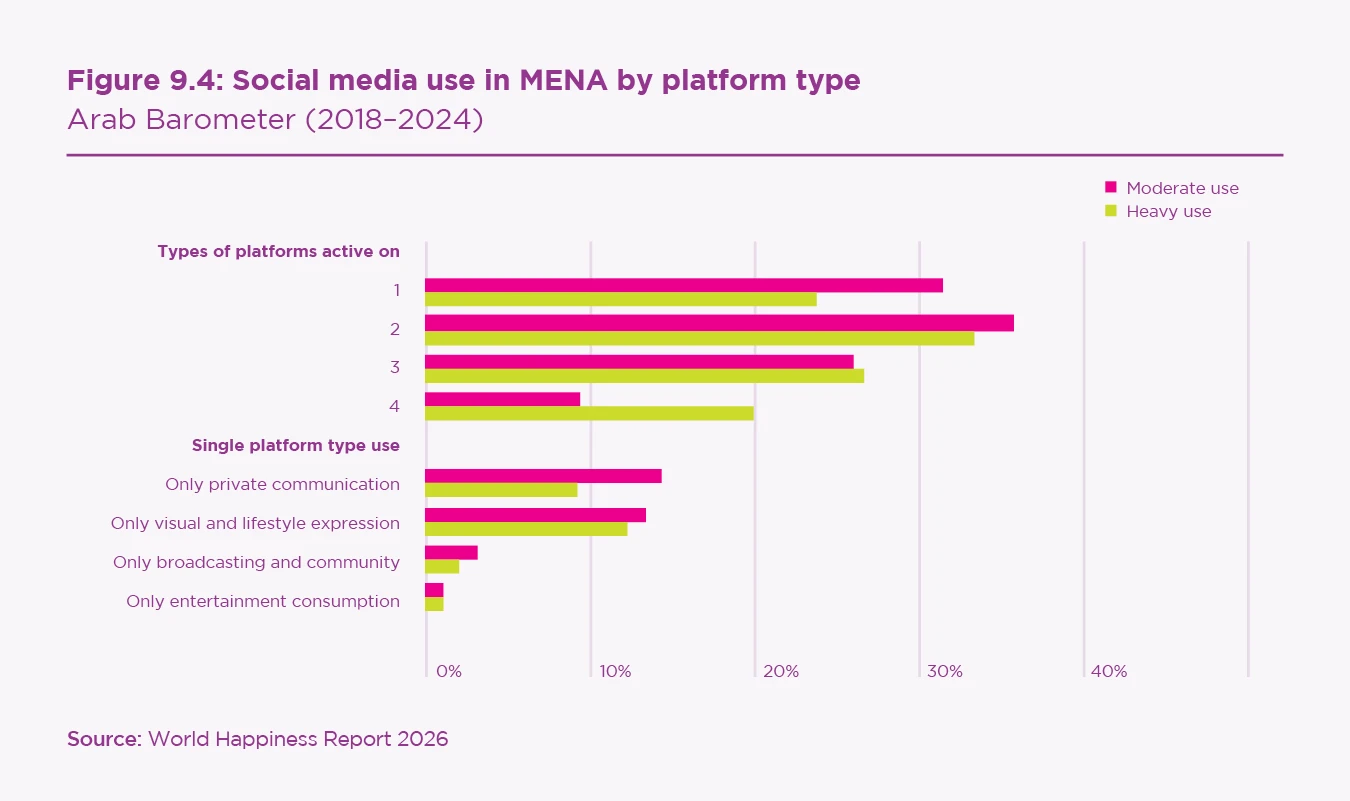 Determine 9.4: Social media use in MENA by platform sort Arab Barometer (2018–2024)
The varied makes use of of social media, mixed with their heavy use, can form how time spent on social media impacts wellbeing within the area. Research performed in different world areas have proven that passive use of social media (significantly on visible and way of life expression apps) is negatively related to wellbeing, whereas energetic participation advantages wellbeing. A number of research have highlighted that social media can amplify the visibility of different life, giving the impression that others have extra satisfying lives. These social comparisons can, in flip, cut back wellbeing. On-line social media use can also improve wellbeing by growing entry to data and strengthening perceived company. As an illustration, by exposing people to sensible information, alternatives, and coping methods, social media can cut back uncertainty and enhance emotions of management over life circumstances, that are positively related to wellbeing.
The info additionally point out fascinating variations between social teams. Most notably, girls are 10% extra doubtless to make use of social media apps for personal communication in comparison with males, regardless of being much less doubtless to make use of social media usually. Being spiritual (versus not or considerably spiritual) is related to the chance of utilizing social media usually, apart from public broadcasting or neighborhood engagement. Though we lack direct proof, these findings counsel that totally different teams in MENA international locations use social media for distinct functions.
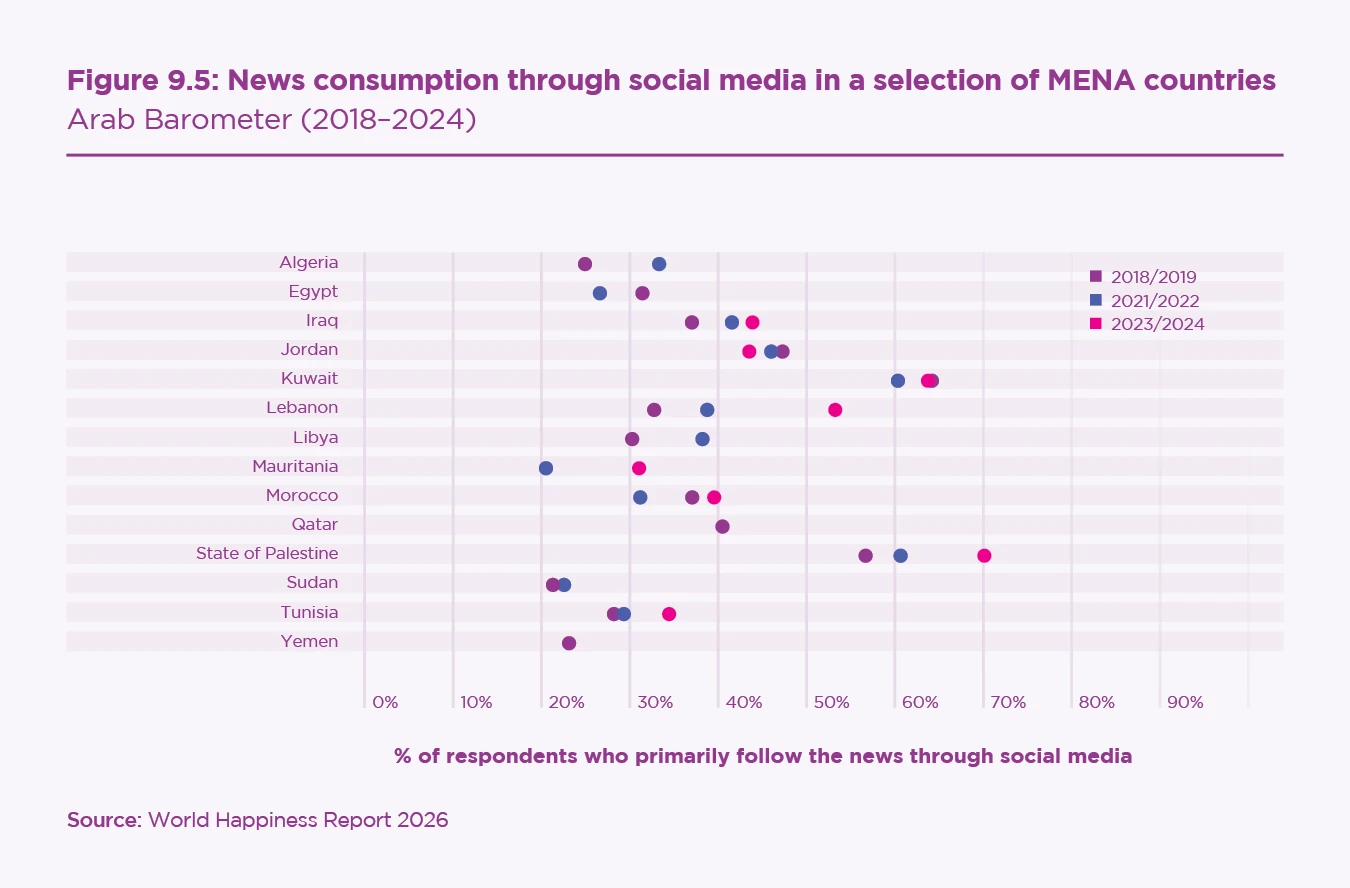 Determine 9.5: Information consumption by social media in a choice of MENA international locations Arab Barometer (2018–2024)
Social media influencers are extremely standard within the MENA area. In response to the 2023–2024 Arab Barometer, 63% of social media customers report having interactions with influencers (see Determine 9.6), the place heavy customers usually tend to observe influencers than average customers. The commonest subjects embody sports activities and recreation (17%), magnificence and style (16%), arts and tradition (14%), meals and cooking (12%), and politics and reform (10%). Whereas most customers primarily watch or like influencer content material, a considerable share engages extra actively: of the heavy customers, 31% remark or ask questions and 22% report making an attempt services or products advisable by influencers.
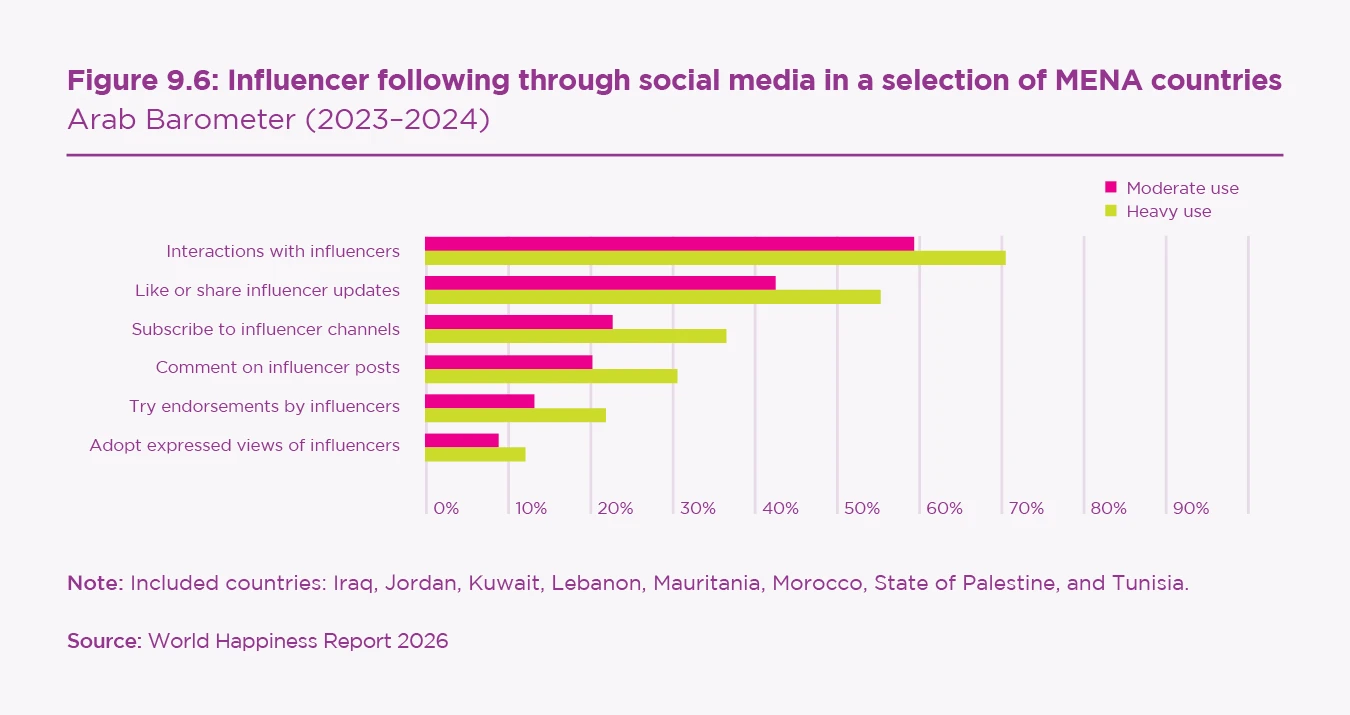 Determine 9.6: Influencer following by social media in a choice of MENA international locations Arab Barometer (2023–2024). Included international locations: Iraq, Jordan, Kuwait, Lebanon, Mauritania, Morocco, State of Palestine, and Tunisia.
Earlier research on the connection between social media use and wellbeing within the MENA area reached blended conclusions. A number of research documented a optimistic relationship between wellbeing and energetic, relational, and significant social media engagement. Different findings from Saudi Arabia, Lebanon, Iran, and Algeria point out, nevertheless, that intense use of platforms resembling Instagram, Snapchat, TikTok, and YouTube is related to decrease wellbeing.
In Saudi Arabia, Alwuqaysi and colleagues surveyed 314 grownup customers (2021–2023), a pattern composed predominantly of Saudi (93%), girls (75%), and extremely educated people. They discovered that social media use is extraordinarily frequent, with 36.6% utilizing social media each couple of hours, 17.5% checking it each hour, and 15% checking it each couple of minutes. Practically 26% of respondents spend 5 or extra hours a day on social media. Nevertheless, though the full time is excessive, periods are quick, with roughly 41.1% spending quarter-hour or much less per login. The overwhelming majority understand their utilization as unhealthy, though it’s largely pushed by the will to keep up household and social connections. Communication platforms (e.g., WhatsApp, Telegram) are seen positively, whereas TikTok is seen as essentially the most dangerous. A big share of customers report anxiousness (69%), habit (65%), and depressive signs (35%) linked to social media use. Moreover, heavy use is constantly related to poor household functioning in Saudi Arabia.
In Lebanon, Malaeb and colleagues performed a proportionate, nationally-distributed family survey (n = 466, imply age ≈ 27, 62% feminine), discovering that adults reported a mean of 6.2 hours per day on social media. Practically 1 / 4 (23.7%) met standards for problematic social media use, outlined as an addiction-like sample of social media engagement characterised by lack of management and continued use regardless of unfavourable penalties. Problematic use was considerably related to greater despair, anxiousness, and insomnia, whereas stress didn’t present a direct affiliation with problematic use.
 Photograph by Nima Motaghian Nejad on Unsplash
Furthermore, Zeeni and colleagues investigated the connection between body-image dissatisfaction and eating-disorder threat with social media use in a pattern of Lebanese college college students (n = 244, 16–21 years, 64% feminine). Outcomes point out that greater physique picture dissatisfaction, larger eating-disorder threat, and decrease self-control are related to larger social media use, pointing to diminished self-regulatory capability as a possible vulnerability channel. In a parallel pattern of Lebanese adults (n = 466), Barbar et al. discovered that anxiousness and social phobia correlate with greater problematic social media use, whereas emotional intelligence partially mediates the affiliation between alexithymia – a persona trait characterised by issue in figuring out, describing, and distinguishing one’s personal feelings that leads people to concentrate on exterior occasions reasonably than inside emotions – and problematic use, once more highlighting emotion-regulation as a protecting/threat issue.
Lastly, in Iran, Akbari and colleagues confirmed throughout two giant on-line cohorts (adolescents n = 562, adults n = 745) that train habit, prevalent in a minority (2.7–4.4%), mediates the hyperlinks between problematic social media use and psychological misery, insomnia, body-image concern, and compulsive consuming. This analysis means that visible comparability cultures (e.g., ‘fitspiration’) can channel digital pressures into compulsive offline behaviours.
Heavy and/or problematic social media use is constantly associated to poor wellbeing and psychological well being.
These research converge on two features. First, heavy and/or problematic social media use is constantly associated to poor wellbeing and psychological well being (together with despair, anxiousness, and sleep disturbance) in each Gulf and Levant (Jap Mediterranean) contexts. Second, the diploma of hurt is determined by who’s utilizing social media and the way they’re utilizing it. Demographic gradients (resembling girls and youthful adults) and psychosocial capacities (together with self-control and emotional intelligence) form outcomes, whereas behavioural conduits like train habit can translate on-line comparability into offline pressure. This sample helps reconcile the blended findings of earlier research. When self-regulation is stronger and engagement is extra relational (e.g., messaging that helps household cohesion), dangers seem extra muted. The place visible comparability and dysregulation dominate, harms are bigger, significantly for younger girls in settings with sturdy body-norm pressures.
The proof additionally reveals variations between platforms. WhatsApp is usually seen positively and related to sustaining household connections and mental engagement. In distinction, visible and short-form platforms, resembling TikTok, Instagram, Snapchat, and YouTube, are linked to unfavourable outcomes, together with physique dissatisfaction, decrease shallowness, and household battle. Fb confirmed blended outcomes: research reported advantages for social capital and happiness within the case of energetic use and elevated despair, anxiousness, and tutorial distraction within the case of passive or extreme use. X (Twitter), whereas extensively used amongst Saudi youth, has much less clear proof of platform-specific outcomes, though some associations with elevated depressive signs have been reported. This implies that whereas the burden of proof factors to harms, the impacts are neither common nor inevitable, relying on patterns of platform use and contextual elements.
Nevertheless, it’s value cautioning that almost all research on the MENA area use comfort samples, which aren’t essentially consultant of the general inhabitants. Within the following sections, we’ll look at the connection between social media use and wellbeing within the MENA area, utilising consultant knowledge from the Arab Barometer.
 Photograph by Hoi An and Da Nang Photographer on Unsplash
We begin by exploring how hours of social media use is said to wellbeing, the place we distinguish between no use, average use, and heavy use (see Field 9.1). Determine 9.7 makes use of SHAP (SHapley Additive exPlanations) dependence plots for example the connection between the time spent utilizing social media and the three measures of wellbeing. SHAP values characterize the marginal contribution of the hours spent utilizing social media to foretell every final result. Optimistic SHAP values point out that extra time spent on social media correlates with greater predicted stress, extra depressive signs, and decrease life high quality in comparison with dad and mom.
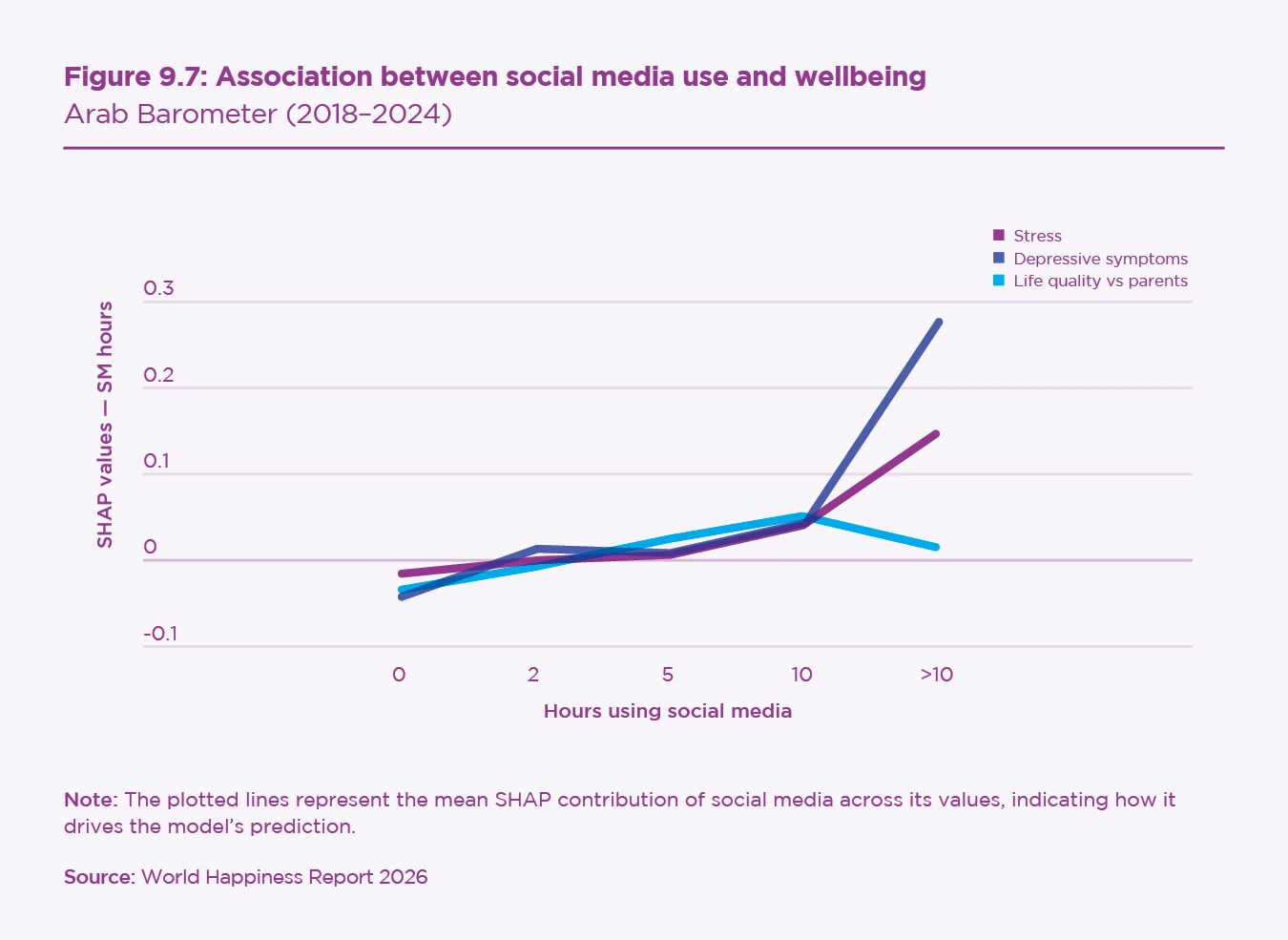 Determine 9.7: Affiliation between social media use and wellbeing. Arab Barometer (2018–2024). Be aware: The plotted strains characterize the imply SHAP contribution of social media throughout its values, indicating the way it drives the mannequin’s prediction.
The plots point out that the affiliation varies throughout totally different ranges of use. Throughout all three outcomes (stress, depressive signs, and relative life high quality), the SHAP curves stay near zero at decrease use ranges, indicating a negligible distinction between non-users and average customers. For all times high quality particularly, the curve already begins to pattern upwards (thus decrease high quality of life in comparison with dad and mom) after roughly three hours of every day use, whereas noticeable will increase in predicted stress and depressive signs emerge amongst customers who spend greater than 5 hours on social media per day. In different phrases, wellbeing variations are modest at low and average publicity, however substantial declines in wellbeing emerge amongst heavy customers. These outcomes help our distinction between average and heavy customers within the Arab Barometer knowledge and align with the broader empirical literature.
In Desk 9.1, Panel A reveals that 28.1% of non- and average customers report feeling depressed typically or more often than not. Nevertheless, this share is 34.5% (+6.4 proportion factors) amongst heavy customers who use social media for 5 or extra hours every day. As soon as we account for the potential position of socio-demographic and financial variables, the estimated distinction in possible despair is, on common, 7.5 proportion factors greater amongst heavy customers in comparison with others. Though modest, this coefficient signifies a significant hole; it’s greater than twice the distinction in depressive signs between employed and unemployed people. Outcomes additionally point out that ladies are inclined to report greater ranges of depressive signs than males, whereas individuals outdoors the labour pressure (resembling college students, homemakers, or retirees) present barely decrease, however not statistically important, ranges of depressive signs in comparison with employed individuals. Richer, higher-educated, and non secular people have a decrease propensity to report depressive signs.
Panel B supplies comparable data for stress. The unconditional prevalence of stress amongst non- and average customers is 33.8%, growing to 39.0% amongst heavy customers. This distinction will increase by 6.6 proportion factors as soon as we account for the potential position of socio-demographic and financial variables. This coefficient is comparable in magnitude to that of unemployed respondents in comparison with employed respondents (+7.3 proportion factors). Analyzing the opposite management variables, we discover that stress is greater amongst Millennials and unemployed people in comparison with those that are employed. As with depressive signs, stress is negatively correlated with schooling, revenue, and religiosity. Ladies report greater stress than males, even after accounting for revenue, schooling and different traits. Therefore, whereas heavy social media use is related to excessive stress, different socio-economic elements, significantly revenue and employment standing, stay sturdy correlates of stress within the MENA area.
Desk 9.1: Social media use, stress, and depressive signs in a choice of MENA countriesArab Barometer (2018–2024)Social media use% of group reporting emotions of despair typically or a lot of the timeLinear chance modelNo/moderate28.1percentReferenceHeavy34.5percent0.075***R-squared0.066Observations11,77611,776Social media use% of group reporting emotions of stress typically or a lot of the timeLinear chance modelNo/moderate33.8percentReferenceHeavy39.1percent0.066***R-squared0.072Observations11,79911,799
Be aware: The second column stories unconditional descriptive statistics. The third column presents outcomes from linear chance fashions on the affiliation between heavy social media use and our two variables of curiosity. Depressive signs (2018–2019) is a binary indicator equal to 1 if the respondent felt depressed typically or more often than not in the course of the previous six months, and 0 in any other case. Stress (2018–2019) is a binary indicator equal to 1 if the respondent felt harassed typically or more often than not in the course of the previous six months, and 0 in any other case. All regressions management for era, gender, schooling, marital standing, employment standing, revenue, religiosity, spiritual denomination (Muslim) and nation fastened results. Significance: * p < 0.10, ** p < 0.05, *** p < 0.01.
Curiously, we don’t discover any proof indicating that the results of social media use are systematically stronger (or weaker) for explicit socio-demographic teams, each within the case of depressive signs and stress. The distinction in stress and depressive signs between heavy and average social media customers is roughly the identical for women and men, for individuals with greater and decrease schooling, throughout revenue teams, and members of varied generations. As an alternative, we discover sizable variations throughout international locations, that are captured by country-specific results. These results take up broad contextual elements (institutional, cultural, and financial) which will have an effect on psychological well being in methods not absolutely captured by our record of management variables.
Do individuals imagine that the standard of their life is best or worse than the standard of their dad and mom’ lives? Desk 9.2 reveals that heavy social media customers have the next chance (36.1%) of reporting they’re worse off in comparison with their dad and mom than non- and average customers (31.6%). Nevertheless, this distinction turns into smaller when controlling for socio-demographic and financial elements within the linear chance mannequin. Holding different variables fixed, heavy customers have a 2.2 proportion level greater chance of feeling worse off in comparison with their dad and mom than non- and average customers. The impact measurement isn’t significantly giant on this case. In actual fact, it corresponds to almost half the impact of being unemployed and about one-fifth of the impact of belonging to the second-poorest revenue group. The opposite variables appeal to coefficients which might be in step with the findings for stress and depressive signs. The chance of reporting being worse off decreases with greater ranges of schooling and revenue; it’s greater among the many unemployed (+4 proportion factors in comparison with the employed) and decrease amongst respondents not within the labour pressure (−4.2 proportion factors in comparison with the employed). Greater ranges of religiosity additionally predict a decrease chance of feeling worse off. Just like our findings for stress and depressive signs, the impact of heavy social media use seems to stay comparatively unchanged for people throughout totally different socio-demographic and financial situations.
Desk 9.2: Social media use and life high quality in comparison with one’s dad and mom in a choice of MENA international locations Arab Barometer (2018–2024)No/moderate31.6percentReferenceHeavy36.1percent0.022**R-squared0.097Observations23,13223,132
Be aware: The second column stories unconditional descriptive statistics. The third column presents outcomes from linear chance fashions on the affiliation between heavy social media use and our variable of curiosity. Life high quality vs. dad and mom (2021–2022 and 2023–2024) is a binary indicator equal to 1 if the respondent stories having a worse high quality of life than their dad and mom. All regressions management for era, gender, schooling, marital standing, employment standing, revenue, religiosity, spiritual denomination (Muslim), nation fastened results, and wave fastened results. Significance: * p < 0.10, ** p < 0.05, *** p < 0.01.
General, the findings counsel that intense engagement with social media is reasonably related to how people consider their very own lives relative to these of their dad and mom, along with its affiliation with stress and depressive signs. One method to clarify this sample is that heavy social media use reshapes the benchmarks used for intergenerational comparability. Progress was historically assessed utilizing age-related milestones resembling marriage, steady employment, or house possession, however social media use directs consideration towards extra fast and symbolic indicators of success, together with luxurious consumption, profession mobility, and on-line visibility. Social media content material is selectively optimistic and extremely seen, so it raises comparability requirements and encourages upward comparisons which might be weakly linked to long-term safety or life-course development. Consequently, heavy customers could also be extra prone to understand themselves as worse off than their dad and mom when it comes to stability and materials safety, whereas concurrently feeling stress to outperform them in way of life or social recognition. This dynamic can produce ambivalence in intergenerational self-evaluations, whereby subjective assessments of 1’s high quality of life fall beneath these of the parental era.
In quickly altering societies, early indicators of progress amongst some teams can generate widespread optimism. Nevertheless, when expectations of shared development stay unfulfilled, this optimism could give method to frustration or protest.
This dynamic is prone to be significantly pronounced in contexts characterised by speedy social change and constrained mobility. Within the Arab context, analysis on youth mobility reveals that youthful generations are significantly better educated and extra digitally linked than their dad and mom, however face restricted job alternatives and weaker prospects for upward mobility in a number of MENA international locations. This sample resonates with the ‘tunnel effect’ described by Hirschman and Rothschild, which means that, in quickly altering societies, early indicators of progress amongst some teams can generate widespread optimism. Nevertheless, when expectations of shared development stay unfulfilled, this optimism could give method to frustration or protest. The digital sphere reproduces this dynamic at scale by exposing younger individuals within the MENA area to selective success tales throughout the globe that elevate hope and aspirations, however typically lead to disappointment when comparable progress proves out of attain. On this regard, feeling worse off than one’s dad and mom could mirror not solely financial realities but additionally repeated publicity to idealised and sometimes unreachable life.
In addition to offering data on how a lot time individuals spend on social media, the Arab Barometer permits us to tell apart between the sorts of social media used. We think about 4 broad forms of social media platforms: (1) visible and way of life expression, (2) personal communication, (3) public broadcasting and neighborhood participation, and (4) leisure consumption. These should not mutually unique, so people can belong to a number of teams (see Field 9.1 for definitions).
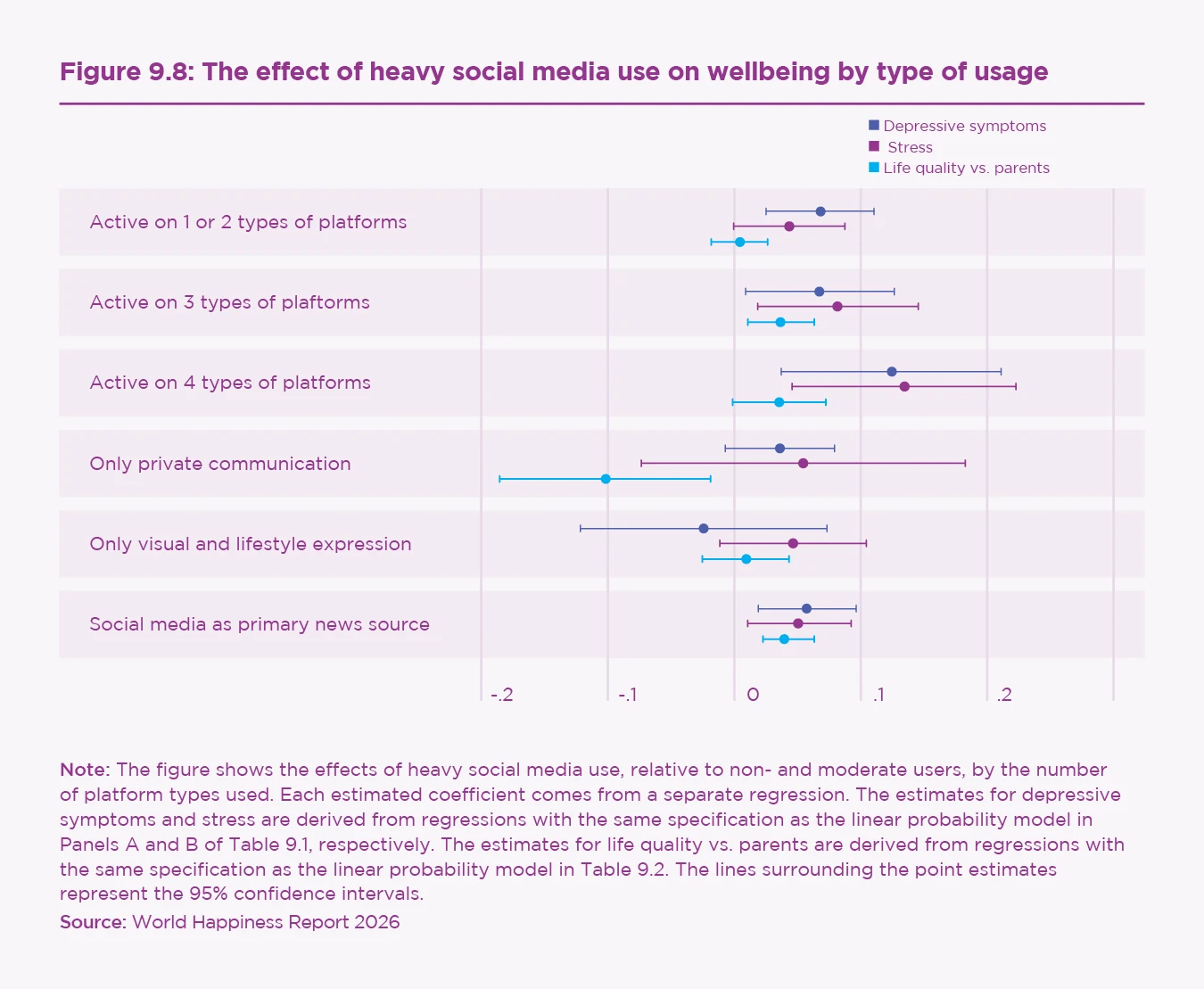 Determine 9.8: The impact of heavy social media use on wellbeing by sort of utilization. Be aware: The determine reveals the results of heavy social media use, relative to non- and average customers, by the variety of platform varieties used. Every estimated coefficient comes from a separate regression. The estimates in Panels A and B are derived from regressions with the identical specification because the linear chance mannequin in Panels A and B of Desk 9.1, respectively. The estimates in Panel C are derived from regressions with the identical specification because the linear chance mannequin in Desk 9.2. The strains surrounding the purpose estimates characterize the 95% confidence intervals.
Throughout research in Lebanon and Saudi Arabia, engagement with influencers and appearance-focused, visually-oriented content material, significantly on Instagram and TikTok, is constantly related to poorer psychological well being and diminished wellbeing, together with greater despair, emotional overeating, disordered consuming signs, and larger psychological misery. Whereas physique picture issues function prominently, these findings level to a broader sample by which platforms emphasising idealised self-presentation heighten younger individuals’s vulnerability to unfavourable self-appraisal. Social comparability processes underpin these outcomes: repeated publicity to curated, filtered portrayals reinforces unfavourable evaluations of 1’s personal talents, look, and life state of affairs, thereby decreasing subjective wellbeing.
The info on high quality of life in comparison with one’s personal dad and mom permits us to tell apart between respondents who observe influencers on social media and people who don’t, and to look at how this interacts with heavy social media use. The outcomes reported within the second column of Desk 9.3 present that following influencers isn’t considerably related to feeling higher or worse off than one’s dad and mom amongst average social media customers. Nevertheless, this modifications when influencer content material is mixed with very intensive use. Heavy customers are considerably extra prone to say that they’re worse off than their dad and mom in the event that they observe influencers. In a linear chance framework, the interplay between heavy use and following influencers is optimistic and statistically important, indicating that the mix of excessive publicity and influencer content material will increase the chance of feeling worse off throughout generations (+6 proportion factors), in contrast with comparable heavy customers who don’t observe influencers. In different phrases, it’s not influencers particularly, however heavy engagement with influencers’ feeds that’s related to a extra pessimistic view of life in comparison with one’s personal dad and mom.
Desk 9.3: The position of influencers on high quality of life in comparison with one’s parentsNo/average useReferenceHeavy use−0.013Interactions with influencers−0.012Heavy use X Interactions with influencers0.060**R-squared0.110Observations12,604
Be aware: Life high quality vs. dad and mom (2023–2024) is a binary indicator equal to 1 if the respondent stories having a worse high quality of life than their dad and mom. All regressions management for era, gender, schooling, marital standing, employment standing, revenue, religiosity, spiritual denomination (Muslim), and nation fastened results. Significance: * p < 0.10, ** p < 0.05, *** p < 0.01.
Curiously, the Arab Barometer permits us to delve additional into the connection between influencers’ feeds and social media use by highlighting varied potential types of interactions with influencers. Determine 9.9 illustrates the affect of heavy social media use on life high quality in comparison with that of fogeys by 5 totally different types of interplay with influencers: solely liking or sharing updates; solely subscribing to channels; commenting on posts; making an attempt endorsements by influencers; and adopting influencers’ views. We distinguish ‘only liking or sharing’ and ‘only subscribing’ as a result of customers who interact in additional intensive interactions (commenting, making an attempt endorsements, adopting views) typically additionally carry out these baseline actions, making the ‘only’ classes helpful for isolating minimal engagement. Heavy social media customers have an 8 proportion level greater chance of feeling worse off than their dad and mom once they strive endorsements. Different types of interplay should not or weakly statistically important. It’s unsurprising that making an attempt endorsements, that are instrumental and promotional interactions, present the strongest relation to the next chance of feeling worse off, on condition that they comprise the predominant type of social comparability.
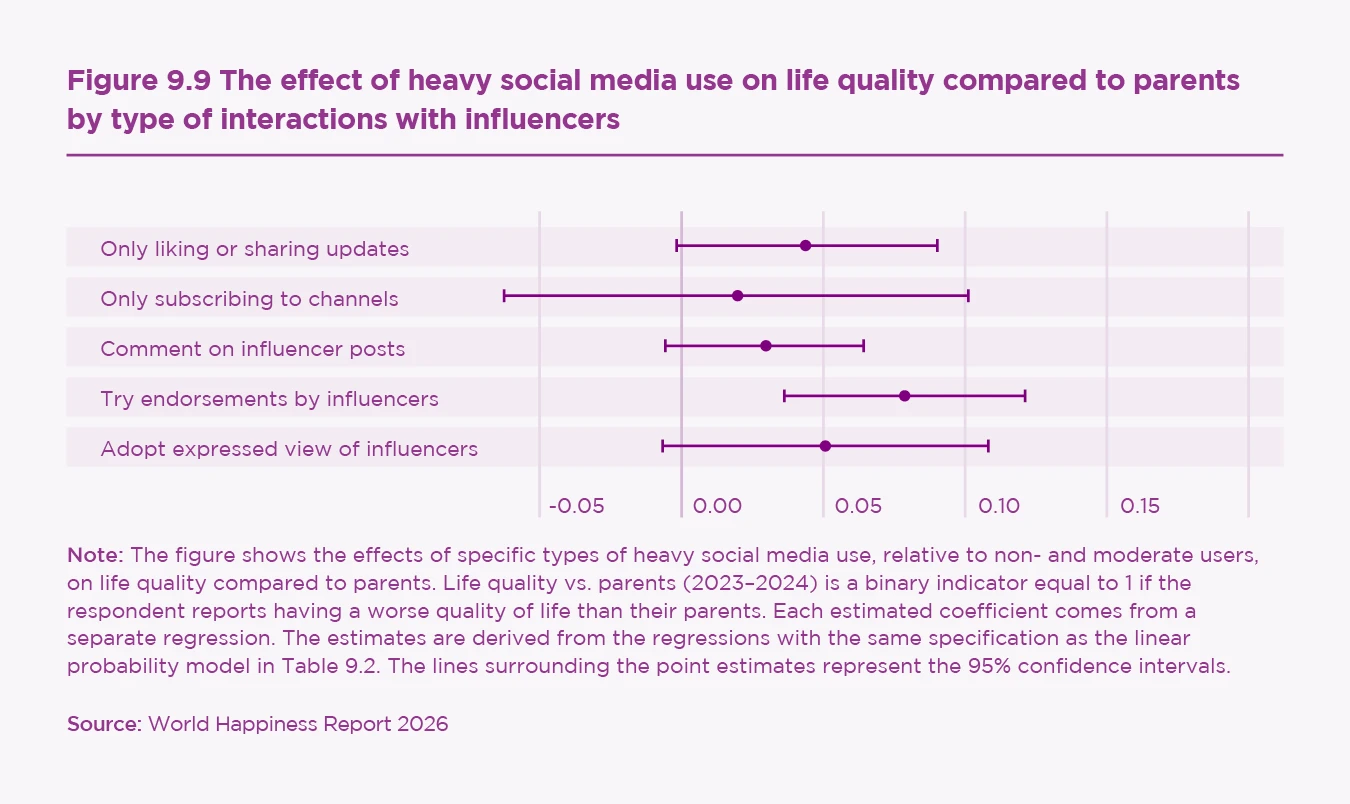 Determine 9.9 The impact of heavy social media use on life high quality in comparison with dad and mom by sort of interactions with influencers. Be aware: The determine reveals the results of particular forms of heavy social media use, relative to non- and average customers, on life high quality in comparison with dad and mom. Every estimated coefficient comes from a separate regression. The estimates are derived from the regressions with the identical specification because the linear chance mannequin in Desk 9.2. The strains surrounding the purpose estimates characterize the 95% confidence intervals.Conclusion
The analyses introduced on this chapter present a nuanced image of social media use and wellbeing within the Center East and North Africa, a world area that has acquired comparatively much less consideration thus far. Whereas the MENA area is commonly characterised by its excessive digital engagement and speedy adoption of latest platforms, our findings present that the implications of social media use for wellbeing are neither uniform nor easy.
A primary perception is that the connection between social media use and wellbeing is nonlinear. For almost all of customers, those that spend as much as 5 hours per day on-line, the affiliation between social media use and stress, depressive signs, and life high quality in comparison with their dad and mom is negligible. It’s only past the edge of 5 hours – which we outline as heavy use – that we observe constant wellbeing losses. In comparison with others, heavy customers report considerably greater ranges of stress and depressive signs, in addition to a larger chance of feeling worse off than their dad and mom. These patterns maintain throughout international locations and demographic teams.
The coefficients of heavy social media use on depressive signs and stress are comparable in magnitude to these related to unemployment, low revenue and schooling ranges.
Moreover heavy social media use, different sturdy correlates of wellbeing embody conventional socio-economic elements resembling religiosity, revenue, employment standing, and schooling. The coefficients of heavy social media use on depressive signs and stress are comparable in magnitude to these related to unemployment, low revenue and schooling ranges. Though some socio-demographic teams use social media greater than others, we didn’t discover proof indicating that heavy social media use impacts explicit teams systematically greater than others. The wellbeing distinction between heavy customers and non- or average customers is comparable for women and men, richer and poorer, extra and fewer educated, and throughout generations.
As well as, our outcomes present that influencer engagement doesn’t have uniform results. Merely following influencers is unrelated to feeling worse off than one’s dad and mom. The unfavourable affiliation arises just for heavy customers who interact in instrumental or promotional interactions, particularly when making an attempt influencers’ endorsements. Subscribing to channels or commenting does seem to hurt wellbeing however to a lesser extent. Nonetheless, extra work is required to grasp how following influencers pertains to wellbeing.
 Photograph by Leilani Angel on Unsplash
Taken collectively, these findings painting a panorama by which social media neither uniformly harms nor advantages wellbeing. Reasonably, outcomes depend upon the depth and mode of use, in addition to the social environments by which digital life unfolds. On this regard, it may be argued that particular patterns of intensive social media use are related to wellbeing. Social media is, initially, a expertise with the potential each to reinforce and to undermine wellbeing, relying on how it’s used. Finally, this chapter underscores the necessity to transfer past common or deterministic narratives concerning the affect of social media.
The Arab world has acquired comparatively restricted consideration from social media and wellbeing researchers however this chapter demonstrates that many patterns recognized in Western contexts additionally emerge within the MENA area. On the identical time, it is very important recognise that some distinct dynamics are at play, together with the roles of gender in shaping social media use, in addition to the affect of faith, cultural norms, and on-line authorities surveillance. These region-specific patterns have solely been addressed to a restricted extent on this chapter and warrant nearer and extra systematic consideration in future analysis.
References
Abbouyi, S., Bouazza, S., El Kinany, S., El Rhazi, Okay., & Zarrouq, B. (2024). Melancholy and anxiousness and its affiliation with problematic social media use within the MENA area: A scientific evaluate. The Egyptian Journal of Neurology, Psychiatry and Neurosurgery, 60(1), 15. https://doi.org/10.1186/s41983-024-00793-0
Abiddine, F.Z.E., Aljaberi, M. A., Gadelrab, H. F., Lin, C. Y., & Muhammed, A. (2022). Mediated results of insomnia within the affiliation between problematic social media use and subjective well-being amongst college college students throughout COVID-19 pandemic. Sleep Epidemiology, 2, 100030. https://doi.org/10.1016/j.sleepe.2022.100030
Akbari, M., Seydavi, M., Zamani, E., & Griffiths, M. D. (2022). The chance of train habit mediates the connection between social media use and psychological well being indices amongst younger Iranians. Habit Analysis & Concept, 32(1), 27–37. https://doi.org/10.1080/16066359.2022.2149742
Al-Ansi, A. M., Hazaimeh, M., Hendi, A., Al-hrinat, J., & Adwan, G. (2023). How do social media influencers change adolescents’ conduct? An proof from Center East International locations. Heliyon, 9(5), e15983. https://doi.org/10.1016/j.heliyon.2023.e15983
Al-Boinin, H., Vatanasakdakul, S., & Zaghouani, W. (2025). Gender, Tradition, and Social Media: Exploring Ladies’s Adoption of Social Media Entrepreneurship in Qatari Society. Administrative Sciences, 15(3), 89. https://doi.org/10.3390/admsci15030089
Alateeq, D., Alhadi, A., Alateeq, F., Alsubie, A., AlEesa, D., AlShareef, S., & Omair, A. (2016). Psychological Effectively-being Amongst Social Community Customers of King Saud College College students. European Psychiatry, 33(S1), S446–S446. https://doi.org/10.1016/j.eurpsy.2016.01.1622
Albeladi, N., & Palmer, E. (2020). The Function of Parental Mediation within the Relationship between Adolescents’ Use of Social Media and Household Relationships in Saudi Arabia. Journal of Info Expertise Administration, 12(2), 163–183. https://doi.org/10.22059/jitm.2020.75799
AlHamad, N. S., & Al Amri’, Okay. (2021). The affiliation between social media use and depressive signs amongst adults in Riyadh, Saudi Arabia. Journal of Household Drugs and Main Care, 10(9), 3336–3342. https://doi.org/10.4103/jfmpc.jfmpc_697_21
Almulla, M. (2020). Social media use for academic functions: Systematic Literature Overview in greater schooling of Center East International locations (MEC). Worldwide Journal of Superior Traits in Laptop Science and Engineering, 9(2), 1935–1944. https://doi.org/10.30534/ijatcse/2020/159922020
Alshaikhi, O. A. M., Alshaikhi, S. A., AlZubaidi, H. A. A., Alzubaidi, M. A. A., Alfaqih, H. M. H., Alrezqi, A. A. A., AlRashdi, M. H. S., Alzubaidi, A. A. A., Alshaikhi, M. A. M., Ghazy, R. M., & Alshaikh, A. A. (2023). Social Media Impact on Private Self-Esteem Among the many Inhabitants in Saudi Arabia. Cureus, 15(11), e49543. https://doi.org/10.7759/cureus.49543
Alshammari, M. M., Al-Mamary, Y. H., & Abubakar, A. A. (2024). Revolutionizing schooling: Unleashing the facility of social media in Saudi Arabian public universities. Humanities and Social Sciences Communications, 11(1), 808. https://doi.org/10.1057/s41599-024-03313-w
Alwuqaysi, B., Abdul-Rahman, A., & Borgo, R. (2024). The Impression of Social Media Use on Psychological Well being and Household Functioning Inside Internet-Primarily based Communities in Saudi Arabia: Ethnographic Correlational Examine. Journal of Medical Web Analysis Formative Analysis, 8, e44923. https://doi.org/10.2196/44923
Alzahrani, M. S. J., Morsi, N. M. A., & Sharif, L. S. (2024). The Relationship between Social Media Use and Melancholy amongst Nursing College students at Governmental College. Proof-Primarily based Nursing Analysis, 3(2), 1–10. https://doi.org/10.47104/ebnrojs3.v3i2.189
Alzahuf, S., Ahmed, E., Al-Badwyi, J. A., Alkhalifa, M. A., Albinessa, M. A., Bashandi, Abdulelah A., Alanazi, D. M., Alawad, F. H., & Alhodibi, M. (2024). Affect of Social Media on Physique Picture and Consuming Dysfunction Prevalence in Adolescents: A Cross-sectional Saudi Examine. Journal of Superior Traits in Medical Analysis, 1(2), 593–598. https://doi.org/10.4103/ATMR.ATMR_104_24
Ansari, S., Iqbal, N., Asif, R., Hashim, M., Farooqi, S. R., & Alimoradi, Z. (2024). Social media use and Effectively-Being: A scientific evaluate and Meta-Evaluation. Cyberpsychology, Habits, and Social Networking, 27(10), 704–719. https://doi.org/10.1089/cyber.2024.0001
Appel, H., Gerlach, A. L., & Crusius, J. (2016). The interaction between Fb use, social comparability, envy, and despair. Present Opinion in Psychology, 9, 44–49. https://doi.org/10.1016/j.copsyc.2015.10.006
Arampatzi, E., Burger, M. J., & Novik, N. (2018a). Social community websites, particular person social capital and happiness. Journal of Happiness Research, 19(1), 99–122. https://doi.org/10.1007/s10902-016-9808-z
Arampatzi, E., Burger, M., Ianchovichina, E., Röhricht, T., & Veenhoven, R. (2018b). Sad growth: Dissatisfaction with life on the eve of the Arab Spring. Overview of Revenue and Wealth, 64, S80–S113. https://doi.org/10.1111/roiw.12388
Bali, O. A., Omer, E., Abdulridha, Okay., Ahmad, A. R. (2021). Psychological Violence Towards Arab Ladies within the Context of Social Media: Internet-Primarily based Questionnaire Examine. Journal of Medical Web Analysis, 23(8), e27944. https://doi.org/10.2196/27944
Barbar, S., Haddad, C., Sacre, H., Dagher, D., Akel, M., Kheir, N., Salameh, P., Hallit, S., & Obeid, S. (2021). Components related to problematic social media use amongst a pattern of Lebanese adults: The mediating position of emotional intelligence. Views in Psychiatric Care, 57(3), 1313–1322. https://doi.org/10.1111/ppc.12692
Batool, S., Younas, D., Sajjad, M., Riaz, S., Jaffri, A. Z., & Mir, T. M. (2025). Social Media Problematic Use and Melancholy: A Quantitative Examine of Pakistani Adults. Journal of Asian Improvement Research, 14(1), 519–523. https://doi.org/10.62345/jads.2025.14.1.40
Borges-Rey, E., Jin, V., Khalid, J., Al Manaa, M., & Khamis, I. (2022). Media use within the Center East, 2021-2022: A seven-nation survey. Northwestern College in Qatar. Retrieved from www.mideastmedia.org/survey/2022
Burger, M. J., & Arampatzi, E. (2025). Imaginative and prescient 2030 and subjective well-being in Saudi Arabia. Sustainability, 17(15), 6856. https://doi.org/10.3390/su17156856
Chegeni, M., Nakhaee, N., Shahrbabaki, M. E., Mangolian Shahrbabaki, P., Javadi, S., & Haghdoost, A. (2022). Prevalence and motives of social media use among the many Iranian inhabitants. Journal of Environmental and Public Well being, 2022(1), 1490227. https://doi.org/10.1155/2022/1490227
Dixon, S. J. (2025). Hottest social networks worldwide as of February 2025, by variety of month-to-month energetic customers. Statista. March, 26. https://www.statista.com/statistics/272014/global-social-networks-ranked-by-number-of-users/?srsltid=AfmBOopxgpEklLi_c__VGALd7acSIV5PL_MJt0XffM1PTzUA3VUQ51B6
Driouchi, A., & Harkat, T. (2017). An Empirical Descriptive Evaluation of the Components underlying the Function of Youthful Generations in Financial, Social & Political Modifications in Arab International locations. MPRA Paper 77216, College Library of Munich, Germany. https://mpra.ub.uni-muenchen.de/77216/1/MPRA_paper_77216.pdf
El Hayek, S., Obeid, S., Kazan, R., Hallit, S., Fekih-Romdhane, F., & Haddad, G. (2025). Mediating impact of despair between problematic social media use and physique dysmorphic issues in adolescents. Uncover Psychological Well being, 5(1), 47. https://doi.org/10.1007/s44192-025-00176-8
Elsayed, H. A. E., Al-Talip, R., Alshamrani, S., Abaood, G., Saran, S., & Alduhaym, L. (2023). The connection between an affect of social media celebrities and physique picture estimation amongst teenage women in Riyadh. Arab Journal of Measurement and Analysis, 4(8), 1–27. https://www.semanticscholar.org/paper/The-Relationship-between-an-Affect-of-Social-and-Elsayed-Al-Talip/66d27bfc3e375cefb75b8c9805685bc471d2dc63
Faqihi, F. A., Qutob, R. A., Subh, R. H. M., Aljathalin, L. A. M., Alshalan, L. Z., Yati, S. M. A., Alaryni, A., Alghamdi, A., Alsolamy, E., Bukhari, A., Alanazi, A., Hazazi, B. H. A., Abuhemid, H. A., Alassaf, R. A., & Alzahrani, S. S. M. (2024). Analyzing the Results of Social Media on Psychological Well being Amongst Adolescents in Saudi Arabia. Cureus, 16(1), e53261. https://doi.org/10.7759/cureus.53261
Farhat, F. (2016). The Relationship between Fb Use, Envy, Wellbeing, and Loneliness amongst Lebanese School College students (SBS thesis, Haigazian College). https://doi.org/10.62811/th.0158
Farooq, A., Salminen, J., Martin, J. D., Aldous, Okay., Jung, S. G., & Jansen, B. J. (2024). Exploring social media privateness issues: a complete survey research throughout 16 Center Jap and North African international locations. IEEE Entry, 12, 147087–147105. https://ieeexplore.ieee.org/doc/10684181
Ghai, S., Magis-Weinberg, L., Stoilova, M., Livingstone, S., & Orben, A. (2022). Social media and adolescent well-being within the World South. Present Opinion in Psychology, 46, 101318.https://doi.org/10.1016/j.copsyc.2022.101318
Hatamleh, I. H., Safori, A. O., & Ahmad, A. Okay. (2023). Exploring the Interaction of Cultural Restraint: The Relationship between Social Media Motivation and Subjective Happiness. Social Sciences, 12(4), 228. https://doi.org/10.3390/socsci12040228
Hirschman, A. O., & Rothschild, M. (1973). The Altering Tolerance for Revenue Inequality within the Course of Financial Improvement. The Quarterly Journal of Economics, 87(4), 544–566. https://doi.org/10.2307/1882024
Jensen Arnett, J. (2017). Life stage ideas throughout historical past and cultures: Proposal for a brand new area on indigenous life levels. Human Improvement, 59(5), 290–316. https://doi.org/10.1159/000453627
Karam, J. M., Bouteen, C., Mahmoud, Y., Tur, J. A., & Bouzas, C. (2023). The Relationship between Social Media Use and Physique Picture in Lebanese College College students. Vitamins, 15(18), 3961. https://doi.org/10.3390/nu15183961
Khodabakhsh, S., & Ahmadi, S. (2020). The connection between subjective happiness and social media utilization in the course of the COVID-19 pandemic: the moderating position of resilience. Aloma: revista de psicologia, ciències de l’educació i de l’esport Blanquerna, 38(2), 105–112. https://www.researchgate.web/publication/349455712_The_relationship_between_subjective_happiness_and_social_media_usage_during_the_COVID-19_pandemic_the_moderating_role_of_resilience
Krasnova, H., Wenninger, H., Widjaja, T., & Buxmann, P. (2013). Envy on Fb: A Hidden Risk to Customers’ Life Satisfaction? Wirtschaftsinformatik Proceedings 2013. 92. https://boris-portal.unibe.ch/server/api/core/bitstreams/d1da93c8-4a7d-46b1-96b7-af6a172c5a73/content material
Lambert, L., Lomas, T., van de Weijer, M. P., Passmore, H. A., Joshanloo, M., Harter, J., Ishikawa, Y., Lai, A., Kitagawa, T., Chen, D., Kawakami, T., Miyata, H., & Diener, E. (2020). In direction of a larger world understanding of wellbeing: A proposal for a extra inclusive measure. Worldwide Journal of Wellbeing, 10(2), 1–18. https://doi.org/10.5502/ijw.v10i2.1037
Lopes, L. S., Valentini, J. P., Monteiro, T. H., Costacurta, M. C. D. F., Soares, L. O. N., Telfar-Barnard, L., & Nunes, P. V. (2022). Problematic social media use and its relationship with despair or anxiousness: a scientific evaluate. Cyberpsychology, Habits, and Social Networking, 25(11), 691–702. https://doi.org/10.1089/cyber.2021.0300
Malaeb, D., Salameh, P., Barbar, S., Awad, E., Haddad, C., Hallit, R., Sacre, H., Akel, M., Obeid, S., & Hallit, S. (2021). Problematic social media use and psychological well being (despair, anxiousness, and insomnia) amongst Lebanese adults: Any mediating impact of stress? Views in Psychiatric Care, 57(2), 539–549. https://doi.org/10.1111/ppc.12576
Matthes, J., Karsay, Okay., Schmuck, D., & Stevic, A. (2020). “Too much to handle”: Impression of cell social networking websites on data overload, depressive signs, and well-being. Computer systems in Human Habits, 105, 106217. https://doi.org/10.1016/j.chb.2019.106217
Nazzal, Z., Rabee, H., Ba’ar, M., & Berte, D. (2021). Nearly alone: extreme Fb use and psychological well being threat in Palestine, a cross-sectional research. Palestinian Medical and Pharmaceutical Journal, 6(1), 53–62. https://doi.org/10.59049/2790-0231.1041
Powell, J., & Pring, T. (2024). The affect of social media influencers on well being outcomes: Systematic evaluate. Social Science & Drugs, 340, 116472. https://doi.org/10.1016/j.socscimed.2023.116472
Pripoae-Şerbănescu, C., & Maţoi, E. (2023). Social Media within the GCC International locations—Facilitator or Curse for Era “Z”? In M. M. Rahman & A. Al-Azm (Eds), Social Change within the Gulf Area (Vol. 8, pp. 17–39). Springer Nature Singapore. https://doi.org/10.1007/978-981-19-7796-1_2
Radcliffe, D., Hadil, A., & Nii, M. (2023). Social Media within the Center East 2022: A Yr in Overview. Obtainable at SSRN: https://ssrn.com/summary=4411239
Rossouw, S., & Greyling, T. (2025). Skilled well-being and compliance behaviour: new purposes of High quality of Life theories, utilizing AI and real-time knowledge. Utilized Analysis in High quality of Life. https://doi.org/10.1007/s11482-025-10535-w
Smidi, A., & Shahin, S. (2017). Social media and social mobilisation within the Center East: A survey of analysis on the Arab Spring. India Quarterly, 73(2), 196–209. https://www.jstor.org/steady/48505308
Tandoc, E. C., Ferrucci, P., & Duffy, M. (2015). Fb use, envy, and despair amongst school college students: Is facebooking miserable? Computer systems in Human Habits, 43, 139–146. https://doi.org/10.1016/j.chb.2014.10.053
Verduyn, P., Ybarra, O., Résibois, M., Jonides, J., & Kross, E. (2017). Do social community websites improve or undermine subjective effectively‐being? A crucial evaluate. Social Points and Coverage Overview, 11(1), 274–302. https://doi.org/10.1111/sipr.12033
Vogel, E. A., Rose, J. P., Roberts, L. R., & Eckles, Okay. (2014). Social comparability, social media, and shallowness. Psychology of Fashionable Media Tradition, 3(4), 206–222. https://doi.org/10.1037/ppm0000047
Zaid, B., Fedtke, J., Shin, D. D., El Kadoussi, A., & Ibahrine, M. (2022). Digital Islam and Muslim millennials: How social media influencers reimagine spiritual authority and Islamic practices. Religions, 13(4), 335. https://doi.org/10.3390/rel13040335
Zeeni, N., Doumit, R., Kharma, J. A., & Sanchez-Ruiz, J. (2018). Media, Expertise Use, and Attitudes: Associations With Bodily and Psychological Effectively-Being in Youth With Implications for Proof-Primarily based Apply. Worldviews on Proof-Primarily based Nursing, 15(4), 304–312. https://doi.org/10.1111/wvn.12298
Endnotes
Editor’s Be aware: That is an up to date model of the unique information article. The preliminary model was revealed at: https://www.worldhappiness.report/ed/2026/social-media-use-and-wellbeing-in-the-middle-east-and-north-africa/.