

This text is the a part of “Policy Pathways for Food and Water Security in the MENA Region”
The Center East and North Africa (MENA) area faces issues of water shortage, restricted arable land, and soil degradation which is exacerbated by local weather change, threatening water and meals safety. Because the area experiences fast inhabitants progress,[1] states should deal with rising demand for water, power, and meals (WEF),[2] that are all inextricably linked. To adapt, the area is striving to enhance climate-smart agricultural practices,[3] cut back waste, and enhance resilience.
This text argues that using nuclear science and applied sciences can provide viable and sustainable pathways for mitigating these challenges. It maps previous and potential purposes of those applied sciences for meals and water safety in MENA, whereas evaluating each feasibility and limitations to implementation and scaling.
The next paragraphs define the potential purposes of nuclear science on varied growth domains within the MENA area.
Strengthening Local weather-Good Agriculture
More Read

The MENA area faces the problem of land degradation from soil erosion in addition to worsening soil high quality resulting from sea degree rise-driven salinisation,[4] rising temperatures, and use of recycled wastewater,[5] negatively affecting crop yields. Nuclear methods assist assess and mitigate soil erosion.[6] Leveraging neutron probing sensors may also help measure soil moisture ranges to find out optimum irrigation software for soil remediation and crop progress.a,[7] That is helpful for saline soil circumstances in MENA, the place typical moisture sensing tools is inadequate. For instance, isotopic methods have supported the cultivation of excessive manufacturing volumes of millet in Lebanon, barley and safflower in Jordan, and quinoa within the United Arab Emirates, materialising by a technical Meals and Agriculture Group- Worldwide Atomic Power Company (FAO-IAEA) cooperation programme.[8]
Enabling Protected Meals Storage
Enhancing meals storage capacities throughout the worth chain is essential for mitigating meals loss and waste within the MENA area. Meals irradiation methods[9] are mild and non-invasive practices that eradicate microbes by exposing meals to radiations like gamma or X-rays, whereas preserving dietary worth and high quality.[10] Opposite to misconceptions, irradiation methods don’t flip meals radioactive. Meals irradiation yields well being and meals security benefits, eliminating microbial contamination and decreasing food-borne illness danger, and is taken into account simpler in comparison with warmth and chemical strategies.[11] Furthermore, it dietary supplements different shelf-life extension strategies.
More Read

Meals irradiation adoption in MENA is at the moment in early-stages,[12] with Egypt main in purposes for meat preservation and phytosanitary compliance. Demand for shelf-stable meals and vegetable imports within the UAE and Saudi Arabia has contributed to funding in new irradiation infrastructure amenities since 2022. Irradiation options are extra widespread in North America and Europe, which have developed authorized frameworks to reiterate its security. A 2025 research by Maataoui et al. evaluating international acceptance of irradiated meals discovered that MENA international locations are extra cautious in regards to the viability of irradiated meals, demonstrating the necessity for public data campaigns to extend public acceptance and implementation feasibility in MENA.[13] Rising meals shelf-life can be helpful for meals safety concerns in distant MENA areas in addition to in battle zones that want humanitarian provides.[14]
Enhancing Water Entry and Effectivity
Whereas the worth proposition of nuclear applied sciences to meals manufacturing is defined by its distinctive scientific capacity to extend crop yields and meals shelf-life, it’s obligatory to spotlight the underlying logic of utilizing nuclear power per se for water desalination, as an illustration, in a area identified for its oil and gasoline wealth.
Standard desalination depends on non-renewables like oil and gasoline which produce vital emissions, regardless of being dependable. Though many international locations within the area have substantial hydrocarbon sources, not all of MENA can depend on such fossil gas abundance. Many international locations within the area have suffered fiscal strains due in no small half to quite giant power import payments. For example, the liberating up of oil and gasoline sources in locations like Egypt, the place it’s getting used for water desalination, would make fiscal sense given excessive import payments for these hydrocarbons.
Alternatively, the energy-exporting MENA international locations should deal with the chance value of the consumption of each barrel of oil domestically—that means one forex-earning barrel of oil much less on the worldwide market. This has cost-implications for a lot of of those international locations working in the direction of financial diversification and funding of their hydrocarbon earnings into new sectors equivalent to AI or manufacturing.
Additional, there are gradual adjustments within the income buffers from MENA’s fossil fuels exports. This downward strain on income streams might moderately be mitigated to some extent by integrating nuclear power into the power portfolio wherever possible, after duly contemplating each prices and dangers related to the kind. Research which centered on Tunisia and Algeria in contrast using oil and gasoline with nuclear for electrical energy technology and water manufacturing, and have successfully demonstrated substantial financial savings from the latter.[15]
More Read

Nuclear power, with its greater power density, provides one of the best baseload different to hydrocarbons.[16] Nuclear-powered desalination leverages reactor-generated warmth and electrical energy to separate salt from seawater, offering a three-fold benefit of lowered emissions, a steady water supply, and low-costs. The mixing of nuclear expertise into the MENA’s water safety portfolios has been led by the Worldwide Atomic Power Company’s (IAEA) sharing of toolkits just like the Desalination Financial Analysis Program (DEEP) and the Desalination Thermodynamic Optimisation Program (De-TOP).[17] Egypt, Jordan, the UAE, Saudi Arabia, Kuwait, and Tunisia have all invested underneath these tips in desalination and isotopetracing. b,[18]
SMR-Powered desalination is into consideration in Saudi Arabia, Egypt, and Kuwait,[19] whereas the IAEA has evaluated research on utilizing SMRs to transform Pink Sea water into ingesting water in Jordan. In international locations just like the UAE which has established a nuclear plant and the place desalination is predominantly fuelled by pure gasoline, coupling desalination vegetation with future nuclear SMRs is projected to yield possible[20] and cost-competitive outcomes.[21] Future nuclear and desalination vegetation could be mixed to provide water as the one end result or yield each electrical energy and pure water by a co-generation system.[22] This mixture, together with methods equivalent to Reverse-Osmosis, Multi-Stage Flash distillation and A number of Impact Distillation, may have comparably beneficial financial savings in each value and emissions.c,[23],[24],[25]
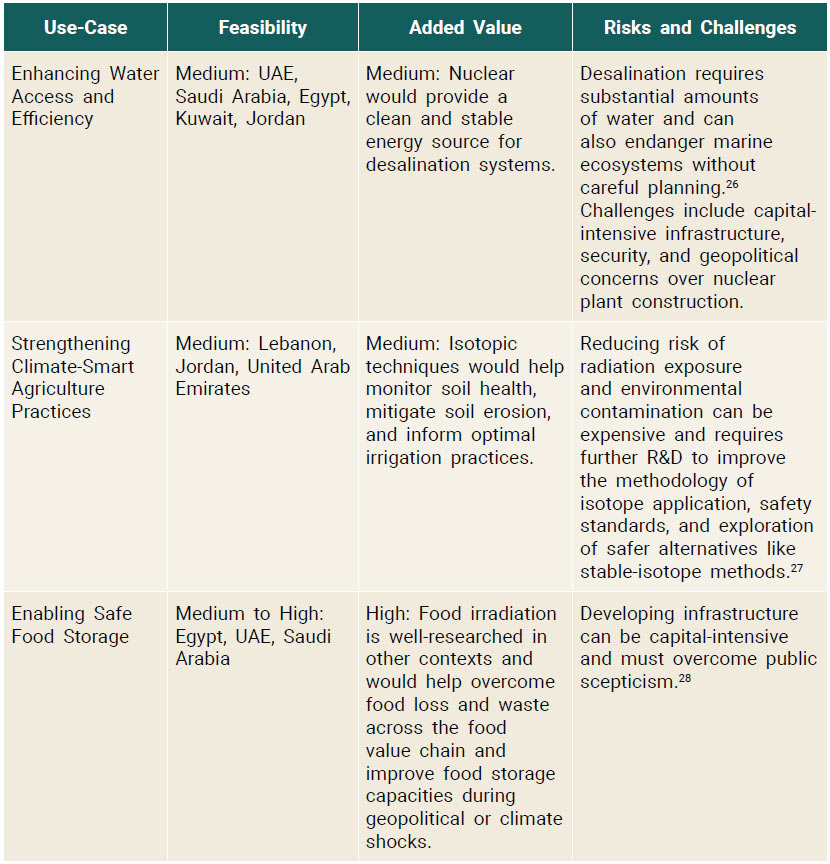
Desk 1. Feasibility, Added-Worth, and Challenges of Nuclear Science and Expertise Functions in MENA
Supply: Authors’ personal, utilizing Neupane et al.[29] and Ihsanullah et al.[30]
Challenges to Nuclear Uptake
Environmental
With out built-in planning,[31]1 the deployment of nuclear power could inadvertently threaten home meals and water provide by consuming huge quantities of freshwater sources to chill methods, and thereby competing with different water-intensive sectors. For instance,[32] oncethrough cooling methods withdraw very excessive volumes of water, recirculating cooling methods trigger excessive water loss from evaporation, and dry cooling methods increase air temperatures. Whereas coastal nuclear vegetation can leverage desalinated water for cooling, desalination brine discharge can imperil marine ecosystems. Transitioning to water-efficient designs remains to be in nascent levels.
Furthermore, routine emissions can pose hostile ecological dangers for soil,[33]3 groundwater, and marine ecosystems. Nuclear vegetation located close to shallow aquifers danger potable water contamination, damages the coastal saline agriculture and endangers marine ecosystems. In arid soil, radioactive isotopes can permeate shortly, resulting in elevated plant uptake.[34] Within the long-term, launched radionuclides can disrupt ecological meals chains, erode genetic variety, and transport to human meals. Though the chance of radioactive waste is considerably mitigated, radionuclides could be launched underneath uncommon and excessive circumstances. Developments in geospatial applied sciences and molecular biology methods may also help mitigate these impacts however rising analysis on safer alternate options like steady isotopes are additionally essential.d,[35]
Regional
The presence of nuclear installations, no matter their type or scale, will increase the securityrisk profile of any area, and these should be factored into any concerns relating to the adoption or deployment of the shape. Though nuclear-based science inputs for agriculture have marginal publicity to dangers of kinetic assaults and harm, the susceptibility of nuclear power powered desalination vegetation to related threats could be appreciable. It might be worthwhile to contemplate the safety umbrellas and supervision bandwidths of every nation when assessing expertise deployment. Moreover, the extent of expertise and experience wanted for adoption and implementation of those applied sciences are substantial, and the area should strengthen its native expertise pool.
Financing
Though governments have signalled curiosity in leveraging nuclear power, there stays a scarcity of infrastructure, funding, and regional coordination to completely capitalise on its potential. Adopting nuclear power comes with prohibitively high-capex necessities, and governments could also be drawn to more cost effective choices.[36] Nuclear power and its worth as a strategic commodity additional entrench the centrality of governmental position in adopting this power type in MENA. The gas provide chains intrinsic to all the worth chain of nuclear power’s use additional ensures that governments would have a extra direct participation within the area quite than non-public gamers. As such, financing stays a governmental prerogative within the area that would profit from enhanced cross-border coordination. Notably, the World Financial institution’s choice[37] to reverse its many years lengthy moratorium on financing nuclear power initiatives in early 2025, when coupled with the organisation’s commitments in the direction of meals safety as a part of its bigger human safety agenda, might show to be a helpful harbinger of change for the MENA area.
Conclusion
Advancing past feasibility assessments for nuclear methods requires coordination between teachers, technical specialists, and policymakers to evaluate long-term environmental implications, put together site-specific precautionary and remediation methods. Notably, initiatives like Atoms4Food[38] and the FAO/IAEA’s Centre for Nuclear Strategies for Meals and Agriculture[39] coordinate utilized analysis and capability constructing and assist safe non-public financing sources.[40]
Thus, establishing regulatory frameworks that lower throughout the heterogeneity of MENA’s constituent nationwide talents would assist create a secure and conducive setting for nuclear deployment for desalination. This may be achieved by making a regional regulatory and supervisory physique to mandate and observe adherence to non-proliferation requirements.[41] The UAE has, as an illustration, set a benchmark by a provision to permit inspections of its nuclear amenities at brief discover. The physique may also mandate integration of mitigation methods for all future desalination infrastructure and develop a strong data-sharing system to measure water ranges and desalination discharge. Such efforts will allow a policy-environment of sharing technical know-how and best-practices, and facilitate trusted adoptions.
Leigh Mante is unior Fellow, Local weather and Power, ORF Center East, UAE.
Cauvery Ganapathy is Fellow, Local weather and Power, ORF Center East, UAE.
Endnotes
[1] United Nations Financial and Social Fee for Western Asia, “Economic and Social Commission for Western Asia Policy Briefs on Food Security Issues in the Arab Region Food SECURITY: Policy Briefs on Food Security Issues in the Arab Region,” UNESCWA, https://www.unescwa.org/websites/default/recordsdata/pubs/ pdf/food-security-issues-arab-region-english_0.pdf.
[2] Jagerskog et al., “The Water-Energy-Food Nexus in the Middle East and North Africa: Scenarios for a Sustainable Future,” Open Information Repository, https://openknowledge.worldbank.org/entities/ publication/11ca3b25-d3ab-5c72-829c-9428fd898164.
[3] United Nations Financial and Social Fee for Western Asia, “Policy Briefs on Food Security Issues in the Arab Region.”
[4] Maha Deeb et al., “The Urgency of Building Soils for Middle Eastern and North African Countries: Economic, Environmental, and Health Solutions,” Science of the Whole Atmosphere 917, 2024: 170529, https://doi. org/10.1016/j.scitotenv.2024.170529.
[5] Deeb et al., “The Urgency of Building Soils for Middle Eastern and North African Countries.”
[6] “Nuclear Techniques to Enhance Nutritional Content in Plants and Protect Soil Health,” Foro Nuclear, November 14, 2024, https://www.foronuclear.org/en/updates/in-depth/nuclear-techniques-to-enhancenutritional- content-in-plants-and-protect-soil-health/.
[7] “Neutron Probe,” Soil Sensor, https://soilsensor.com/articles/neutron-probe/.
[10] “How Food Irradiation Works,” CDC Radiation and Your Well being, February 27, 2024, https://www.cdc.gov/ radiation-health/food-irradiation/index.html.
[11] Worldwide Atomic Power Company, “What Is Food Irradiation and Why Is It Important?”
[12] “Food Irradiation Market Size ($408 Million) 2030,” Strategic Market Analysis, November, 2025, https:// www.strategicmarketresearch.com/market-report/food-irradiation-market#:~:textual content=Adoptionpercent20ispercent20 stillpercent20inpercent20its,stagepercent2Cpercent20securitypercent2Dfocusedpercent20adoption.
[13] Jaber Maataoui et al., “Global Perceptions and Acceptance of Irradiated Food: A Comparative Systematic Review,” Italian Journal of Meals Security 14, no. 2 (Might 2025), https://doi.org/10.4081/ijfs.2025.12885.
[14] Worldwide Atomic Power Company, “What Is Food Irradiation and Why Is It Important?”
[15] World Nuclear Affiliation, “Desalination,” Might 2, 2024, https://world-nuclear.org/information-library/nonpower- nuclear-applications/business/nuclear-desalination.
[17] “Nuclear Desalination,” IAEA, https://www.iaea.org/subjects/non-electric-applications/nuclear-desalination.
[18] “Monitoring Soil-Water-Nutrient Interaction Using Isotope and Nuclear Techniques,” IAEA, October 2018, https://www.iaea.org/websites/default/recordsdata/18/10/monitoring-soil-nutrient-interaction-using-isotope-andnuclear- methods.pdf.
[20] Mussie Naizghi et al., “Nuclear Desalination and Its Viability for the UAE,” 2011, https://doi.org/10.13140/2.1.5146.3044.
[21] Muhammad Zubair and M. S. Sajna, “Techno-Economic Analysis of SMR Integration into UAE’s Existing Desalination Infrastructure,” Annals of Nuclear Power 227, pt. B (2026): 111989, https://doi.org/10.1016/j. anucene.2025.111989.
[22] Mussie Naizghi et al., “Nuclear Desalination and Its Viability for the UAE.”
[23] World Nuclear Affiliation, “Desalination.”
[24] “Multi-Stage Flash,” Science Direct, https://www.sciencedirect.com/subjects/engineering/multi-stage-flash.
[25] “Multiple-Effect Desalination,” Science Direct, https://www.sciencedirect.com/subjects/engineering/multipleeffect- distillation.
[26] Sustainability Listing, “How Does Nuclear Energy Affect Water Resources?,” December 6, 2025, https:// power.sustainability-directory.com/query/how-does-nuclear-energy-affect-water-resources/.
[27] Basanta Neupane et al., “Advancement in Agriculture through Radioisotopes: Current Context, Challenges, and Future Directions,” Journal of Agriculture and Meals Analysis 21 Half B, 2025, https://doi.org/10.1016/j. jafr.2025.101966.
[28] Ihsanullah and Rashid, “Current Activities in Food Irradiation as a Sanitary and Phytosanitary Treatment.”
[29] Neupane et al., “Advancement in Agriculture Through Radioisotopes: Current Context, Challenges, and Future Directions.”
[30] Ihsanullah and Rashid, “Current Activities in Food Irradiation as a Sanitary and Phytosanitary Treatment.”
[31] Sustainability Listing, “How Does Nuclear Energy Affect Water Resources?”
[32] Sustainability Listing, “How Does Nuclear Energy Affect Water Resources?”
[34] Dangle Yang et al., “Unravelling the Nuclear Isotope Tapestry: Applications, Challenges, and Future Horizons in a Dynamic Landscape,” Eco-Atmosphere & Well being 3, no. 2 (2024): 208–226, https://doi.org/10.1016/j. eehl.2024.01.001.
[35] Worldwide Atomic Power Company, “Stable Isotopes,” https://www.iaea.org/subjects/nuclear-science/ isotopes/stable-isotopes.
[36] Worldwide Atomic Power Company, “Funding and Finance,” https://www.iaea.org/subjects/funding-andfinance#:~: textual content=Thepercent20IAEApercent20alsopercent20publishespercent20financial,constructionpercent20topercent20addingpercent20 additionalpercent20units.
[38] Worldwide Atomic Power Company, “Atoms4Food,” https://www.iaea.org/providers/key-programmes/ atoms4food.
[39] Meals and Agriculture Group of the United Nations and Worldwide Atomic Power Company, “Joint FAO/IAEA Centre of Nuclear Techniques in Food and Agriculture,” https://www.fao.org/agriculture/fao-iaeanuclear- methods/en.
[40] Worldwide Atomic Power Company et al., “Atoms4Food: Transforming Agrifood Systems With Nuclear and Isotopic Techniques,” 2023, https://www.iaea.org/websites/default/recordsdata/atoms4food-growing-food-security.pdf.
[41] Yang et al., “Unravelling the Nuclear Isotope Tapestry: Applications, Challenges, and Future Horizons in a Dynamic Landscape,” 208–226.