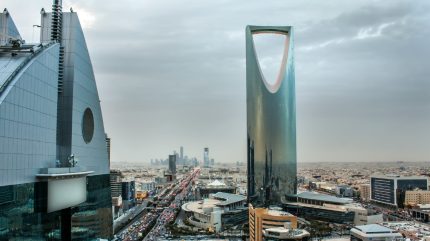


How diversification within the Center East is powering development
The present strengths and potential of MENA place it to profit from its demographic profile (Reuters)
When high economists have been just lately requested to weigh in on the trajectory of the worldwide economic system, they painted an unsettling image. Disruption and uncertainty have taken a toll, in response to responses gathered for the World Financial Discussion board’s newest “Chief Economists’ Outlook.”
But, one area stood aside: the Center East and North Africa. Thirty-seven % of the chief economists surveyed for the September version anticipate sturdy or very sturdy development for the area within the 12 months forward, up sharply from 22 % in Might. Chief economists weren’t as optimistic about some other area. The following-highest share anticipating sturdy or very sturdy regional development was 31 % for South Asia. For some distinguished areas within the West, optimism about development was negligible or nonexistent.
That divergence displays that MENA’s financial second is being powered much less by world financial cycles or the area’s entry to pure assets, however by one thing extra basic: a forward-looking technique by regional governments, particularly these within the Gulf, for deliberate diversification and far-reaching funding into innovation, inclusion, sustainability and resilience — the basic pillars of long-term, higher-quality financial development.
More Read
Oil manufacturing, after all, stays an vital pillar and, whereas plans are underway to spice up oil manufacturing, the area has additionally been ramping up its renewable vitality assets at placing velocity. Photo voltaic photovoltaic capability in MENA is anticipated to extend tenfold by 2035, because the share of renewables in its general electrical energy technology reaches 25 %. In the meantime, its nuclear capability is projected to triple.
The area’s financial second is being powered much less by world financial cycles however by one thing extra basic
More Read

Attilio di Battista
As a part of its Imaginative and prescient 2030 transformation plan, Saudi Arabia just lately dedicated to investing about $8 billion in new home photo voltaic and wind vegetation with a collective capability of 15,000 megawatts (a single megawatt photo voltaic array operating for an hour is adequate to energy an electrical automobile from Riyadh to Oslo).
One other ingredient of Imaginative and prescient 2030 is a proactive synthetic intelligence technique, with Saudi Arabia investing closely within the vital knowledge facilities, infrastructure and startups. The UAE has additionally made AI a precedence. Its “Stargate” initiative is a partnership with OpenAI that’s meant to ship a supercomputing cluster that will qualify as important nationwide infrastructure. OpenAI has estimated that the UAE-based venture has the potential to supply sufficient computing capability for the wants of half the world’s inhabitants.
These AI ambitions complement Dubai’s evolution as a worldwide monetary hub, the place the general variety of corporations working in banking and capital markets elevated by almost a fifth in the course of the first half of 2025, whereas these specializing in fintech and innovation jumped by 28 %. Qatar, in the meantime, plans to double photo voltaic vitality manufacturing by 2030, whereas advancing its personal AI and rising know-how ecosystem.
More Read
These investments in innovation and know-how are complemented by efforts to strengthen human capital and leverage the great demographic potential of the area. Saudi Arabia has just lately launched sector abilities councils to align schooling and reskilling applications with industries’ wants, following the profitable mannequin that historically existed in lots of Northern European nations. Each Saudi Arabia and the UAE are among the many nations on the planet which have made probably the most progress to shut gender gaps previously 20 years.
For lots of the Gulf nations, sustaining progress and diversifying their economies will rely on the success of those far-reaching, interdependent reforms and investments that target the standard as a lot as the amount of financial development. Creating home innovation capability, sharing the advantages of innovation inclusively and making certain that sustainability and resilience underpin growth: all these elements will probably be essential to make sure that development stays resilient amid a shifting world panorama.
The present strengths and potential of MENA place the area to profit from its demographic profile
Attilio di Battista
Nonetheless, the area stays extraordinarily numerous. Throughout North Africa and the Levant, some nations proceed to face conflict-related disruptions and infrastructure gaps, low funding in human capital and an absence of innovation and enterprise dynamism. Many of those nations are taking steps to deal with these limitations, together with with investments in each digital and bodily infrastructure.
Morocco has been capable of mix a talented workforce, heavy investments in fashionable port and rail infrastructure, and commerce integration with the northern aspect of the Mediterranean to grow to be a producing powerhouse. Additional efforts are wanted to make sure progress is shared extra broadly all through the area.
The important thing query, then, isn’t whether or not the area can proceed to develop however whether or not present development could be transformed into lasting prosperity all through the area. It’s a significantly helpful query to ask of MENA’s economies now, on condition that the area nonetheless retains a lot untapped development potential. Greater than half of the respondents within the newest “Chief Economists’ Outlook,” 54 %, rated the area’s untapped development potential as excessive or very excessive — far above Europe and solely barely behind Latin America.
The present strengths and potential of MENA place the area to profit from its demographic profile. The primary half of this century is ushering an enormous proportion of MENA’s comparatively youthful inhabitants into what ought to be its most efficient years. It’s time to seize the second.
Divergence was an overriding theme of the “Chief Economists’ Outlook,” between superior and creating economies and throughout areas transferring at completely different speeds. Some will wrestle to adapt to a fragmenting world economic system. Others will discover alternatives amid change.
The Center East seems to be among the many latter. If the area can flip financial diversification into inclusive, sustainable and resilient prosperity, it is not going to simply defy world tendencies — it may redefine the worldwide playbook for sustainable development within the twenty first century.
Attilio di Battista is the Head of Financial Progress and Transformation on the World Financial Discussion board.
Disclaimer: Views expressed by writers on this part are their very own and don’t essentially replicate Arab Information’ perspective