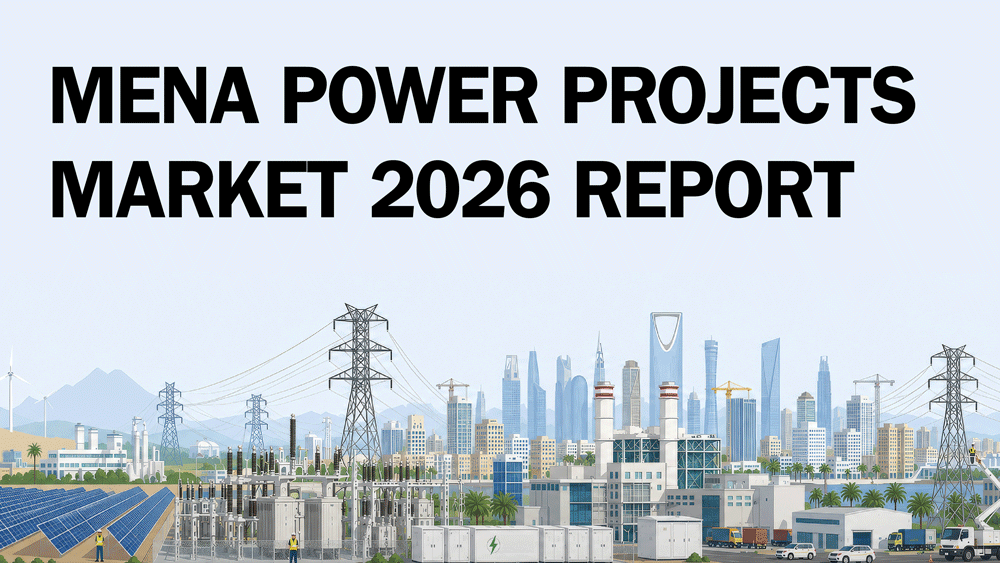


• Almost 15 GW of latest photo voltaic, wind and storage capability deployed in 2025, shifting MENA into an exponential progress section• Undertaking pipeline reaches 202 GW throughout renewables, hydrogen and storage, forward of prior mannequin situations• Saudi Arabia, UAE and rising markets in Iraq, Uzbekistan and Azerbaijan achieve strategic relevance for Europe and international clear provide chains
The MENA vitality transition entered a brand new section of scale and competitiveness in 2025, in response to the most recent Dii Desert Vitality outlook unveiled throughout Abu Dhabi Sustainability Week. The report charts a pointy acceleration in photo voltaic, wind and vitality storage deployment, with the area including almost 15 gigawatts of latest capability in a single 12 months, pushed by value breakthroughs and multi gigawatt pipelines now extending to hydrogen and grid scale batteries.
MENA Begins to Scale at Velocity
The World Future Vitality Summit offered the stage for Dii Desert Vitality to launch its flagship annual report “MENA Energy Outlook 2026” to diplomats, policymakers and buyers gathered for Abu Dhabi Sustainability Week. The analysis builds on the 2025 version however exhibits materially quicker traits than the earlier modelling anticipated, particularly in mixed photo voltaic plus storage techniques and grid linked hydrogen hubs.
H.E. Eng. Sharif Al Olama, Undersecretary for Vitality and Petroleum Affairs on the UAE Ministry of Vitality and Infrastructure, framed the acceleration when it comes to coverage priorities. “In light of the dual challenges of climate change and energy security, a rapid and sustained scale up of renewable energy is no longer optional. It is essential. The UAE recognized this early, and we have committed to tripling our renewable energy capacity by 2030, strengthening our ambition by increasing the renewable energy target from 14.2 gigawatts to a clear target of more than 22 gigawatts of installed renewable energy capacity, including solar, concentrated solar power, wind and waste to energy within the next five years.”
More Read

H.E. Eng. Sharif Al Olama, Undersecretary for Vitality and Petroleum Affairs on the UAE Ministry of Vitality and Infrastructure
He added that the information infrastructure behind selections is changing into as essential because the belongings themselves. “As we accelerate this transformation, access to reliable, high quality data and forward looking analysis becomes critical to sound policymaking, investment decisions and regional coordination. In this context, the MENA Energy Outlook 2026 provides valuable and timely insights into the trends, risks and opportunities shaping the energy future of our region.”
Markets Drive Breakthrough Pricing
More Read

A number of executives described 2025 as a turning level for purely market pushed deployment. Cornelius Matthes, CEO of Dii Desert Vitality, noticed that “2025 can be described as a breakthrough year for the energy transformation in the MENA region, with an unprecedented surge in new capacity for both solar PV, wind and BESS, all purely driven by market factors with the lowest prices globally.”
 Cornelius Matthes, CEO of Dii Desert Vitality
The report particulars how regional capability grew from roughly 14 GW in 2020 to 30 GW in 2024, earlier than leaping by almost 15 GW in simply twelve months. Value curves throughout the area proceed to outcompete fossil belongings on new construct economics. Saudi Arabia secured international document lows for levelized value of electrical energy at 1.09 US cents per kilowatt hour for photo voltaic and 1.33 US cents for wind, whereas battery vitality storage techniques now obtain capital prices within the USD 73 to 75 per kilowatt hour vary.
RELATED ARTICLE: Meta, NextEra Agree 2.5 GW Clear Vitality Buildout To Energy Increasing US Knowledge Infrastructure
UAE and Saudi Arabia Anchor a Wider Pipeline
The UAE consolidated its place as a renewable hub for the area, rating second with 7.5 GW of operational capability and advancing a big execution pipeline. Masdar, in partnership with EWEC, has begun building on a 5.2 GW photo voltaic park coupled with 19 GWh of battery storage designed to ship one gigawatt of baseload clear energy. Mohamed Jameel Al Ramahi, CEO of Masdar, mentioned the findings “clearly show that the region has reached a decisive inflection point. The acceleration of renewable energy deployment now underway demonstrates the potential of renewables to outperform conventional energy on cost, speed of deployment, resilience and returns. This reinforces MENA’s position as global leader in delivering affordable, scalable clean energy, while supporting energy security and long term economic growth.”
More Read

 Mohamed Jameel Al Ramahi, CEO of Masdar
Saudi Arabia’s value management has pulled capital right into a wider pipeline as the general regional mission slate reached 202 GW, effectively above the 165 GW “balanced transition” situation modelled within the 2025 version. Hydrogen is shifting at a extra measured tempo however the report finds seen execution. The NEOM Inexperienced Hydrogen mission is 80 p.c full and the Yanbu Inexperienced Hydrogen Hub, developed with Germany’s EnBW, anchors new industrial and geopolitical hyperlinks between the Gulf and Europe.
New Entrants and Regional Connectors
Iraq is rising as a gigawatt scale market with a goal of 12 GW by 2030 and a number of initiatives now in building. Central Asia is catching up, with Uzbekistan and Azerbaijan positioning themselves as strategic nodes for east west connectors by the Caspian Sea into the European Union.
Rising storage deployment, hydrogen hubs and cross border transmission plans collectively shift the area from remoted nationwide markets to a extra interconnected clear vitality system that would serve Europe, Africa and South Asia.
Implications for Buyers and Policymakers
For institutional buyers, the report highlights falling threat premiums on renewables in Gulf markets, maturing procurement frameworks, and engaging LCOE benchmarks that evaluate competitively towards fossil alternate options. For governments, the findings reinforce the necessity for grid planning, storage requirements and secure offtake constructions to combine multi gigawatt photo voltaic parks and hydrogen hubs.
The report closes on the worldwide stakes of the shift. If MENA maintains its present trajectory, the area may develop into probably the most vital suppliers of low value clear vitality, hydrogen and storage applied sciences by 2030, with penalties for vitality safety, industrial coverage and local weather pathways throughout Europe and Asia.