

What do you get when capital abundance, regulatory innovation, and excessive environmental stakes converge?
Whereas enterprise capital funding is struggling to get well in lots of world areas, the Center East and North Africa (MENA) area’s VC trade posted report highs for 2025.
The area stays a web importer of meals and intensely susceptible to local weather change occasions like excessive warmth, rising sea ranges, and water shortage. (MENA is residence to six.3% of the worldwide inhabitants however holds simply 1.4% of worldwide freshwater, for instance.)
These elements necessitate innovation that would later function a blueprint for different areas dealing with local weather challenges.
In the meantime, geopolitical occasions, together with Covid-19 and the Ukraine Battle, have elevated meals safety to a nationwide precedence equal to vitality safety, with express targets to extend output in nations’ 10-, 20-, and 30-year imaginative and prescient plans, together with:
More Read
Tech and infrastructure indicators in MENA
Sovereign wealth funds are a foundational element of MENA’s monetary panorama. They function on a unique timeframe than conventional enterprise capital—10 to twenty years versus 5 to 7—and concentrate on strategic worth over purely monetary returns. This allows decades-long R&D cycles and infrastructure-scale investments in applied sciences that inherently take longer to develop. Assume quantum computing, clear energy, and vertical farming infrastructure.
Since 2023, sovereign funds within the area have pumped tons of of billions of this “patient” capital into AI and tech, with a concentrate on home deployment.
More Read
The UAE has made explicit strides in AI infrastructure.
Saudi Arabia’s sovereign wealth fund PIF is projected to speculate a whopping $2 trillion by 2030, unmatched within the area, in response to Gaia. Different investments embody:
$40 billion earmarked for an AI fund
$100 billion for superior manufacturing through the Alat initiative
Greater than $500 billion into the NEOM good cities mission, together with The Line city growth mission.
Each initiatives deal with the area’s local weather vulnerabilities and ongoing want for sources. NEOM and The Line embody initiatives round water administration and clear energy to satisfy the anticipated 50% surge in demand.
Elsewhere, Qatar has a $1 billion price range for quantum computing R&D in its nationwide technique and the area’s first quantum lab. Egypt holds an energetic startup ecosystem, a big home market with its 120-million-strong inhabitants, and a pathway for startups to entry the Gulf Cooperation Council (GCC) area, which incorporates Bahrain, Kuwait, Oman, Qatar, Saudi Arabia, and the UAE.
Regulatory innovation as a aggressive benefit
More Read

A number of of the area’s nations have demonstrated a quicker, extra complete regulatory pathway for brand spanking new applied sciences than different components of the world. These developments may place MENA as a significant world competitor in areas like novel meals and vitamin. Examples embody:
Abu Dhabi is creating a regulatory framework for novel meals that reduces the registration interval to only six to 9 months versus 18 to 36 months within the US and EU. It can additionally consolidate registration for brand spanking new meals merchandise, halal certification, and manufacturing/import permits, thus accelerating market entry.
It has additionally up to date its halal certification course of to align with world requirements, strengthening export competitiveness within the Muslim shopper market, estimated at 1.8 billion folks.
Qatar is the second nation on this planet to approve the sale of cultivated meat following its funding and manufacturing plans into Eat Simply’s GOOD Meat, the place it led the corporate’s $200 million spherical.
The UAE has a number of regulatory sandboxes that permit for speedy growth and “an agile regulatory environment” for brand spanking new applied sciences equivalent to AI.
Consistent with world well being tendencies, Saudi Arabia launched new rules round meals transparency, together with front-of-pack labeling and calorie disclosures on menus.
The area’s gene-editing panorama is turning into more and more aggressive by adopting versatile, product-based frameworks that align extra carefully with the permissive US mannequin than the historically restrictive EU requirements, fostering a quicker path to commercialization for non-transgenic improvements.
By the numbers:
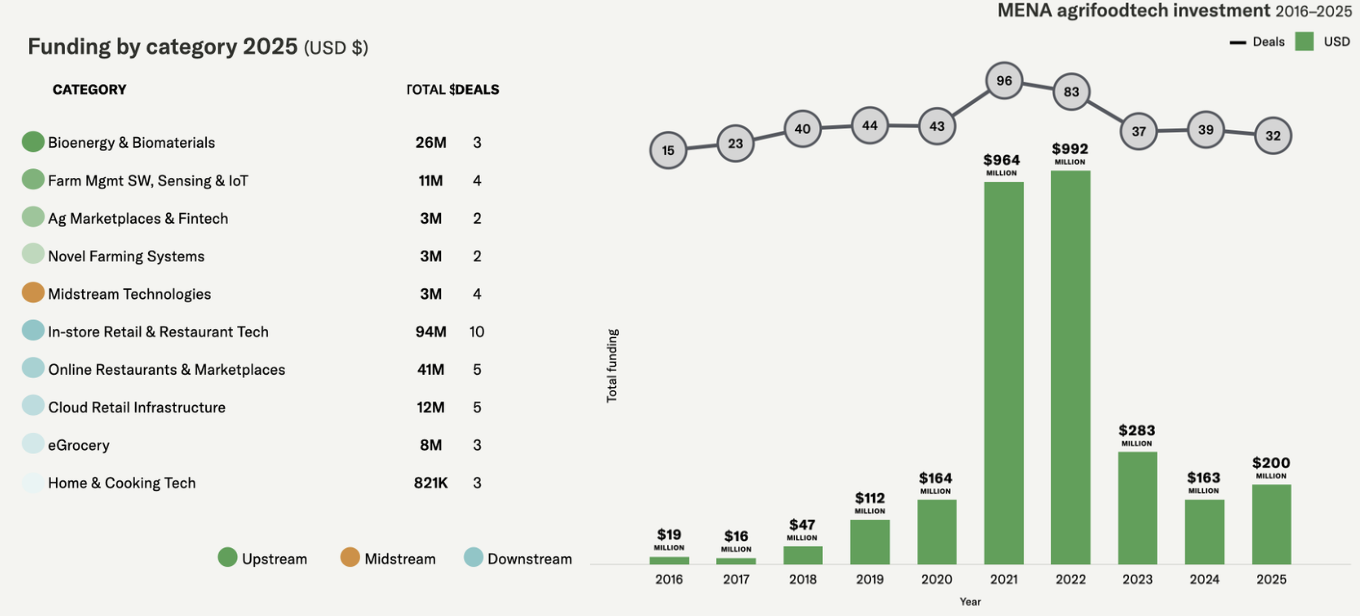
Of the $153.73 billion in whole enterprise capital funding in MENA between 2015 and 2025, simply over 5% went to agrifoodtech at practically $3 billion. This share of GDP is on par with world ranges, although decrease than the trade’s 13% contribution to regional GDP.
The next firms supply a snapshot of main regional agrifoodtech firms to-date by funds raised and strongest classes:
Kitopi: raised $800+ million (largest exit candidate, cloud kitchens)
Pure Harvest: $330 million (vertical farming infrastructure)
Acquired Pink Sea Farms in 2023 for its saltwater agriculture innovation
Nana: $210 million (eGrocery regional chief)
Foodics: $200 million (restaurant SaaS)
Agrifoodtech startups raised 22% extra in funding in 2025, albeit over fewer offers than in earlier years. But the cut up by classes tells us little of the area’s potential as outlined above. In 2026, the query is whether or not the above developments and targets shall be mirrored in MENA’s VC funding totals.
Supply: AgFunder