

COP30 was meant to ship for the worldwide south. As an alternative, blurred finance pathways, obscure commitments and delayed adaptation finance targets didn’t match the urgency on the bottom, leaving MENA international locations uncovered to worsening local weather extremes.
COP30 in Belém was much less about grand new guarantees and extra about testing whether or not the system can lastly ship for frontline international locations, particularly for the MENA area. From finance to adaptation, COP30 noticed a bumpy course of and a sophisticated consequence overshadowed by voluntary presidency initiatives that don’t present readability on how they might be embedded into the precise UNFCCC course of.
On finance, the headline consequence was the Belém Package deal and its companion World Mutirão determination (Mutirão is a Brazilian Portuguese time period referring to collective effort). These two sketch a roadmap to mobilise round USD 1.3 trillion a yr in local weather finance for growing international locations by 2035, constructing on the New Collective Quantified Objective agreed in Baku final yr. Nonetheless, this can be a compromised timeline. A core a part of this consequence package deal was textual content explicitly stating “call for efforts” to no less than triple adaptation finance by 2035 in comparison with 2025 ranges.
Whereas that is clearly weak language, it does ship an essential political sign that the traditionally mitigation-centric focus of local weather finance is beginning, no less than rhetorically, to maneuver towards a extra balanced strategy that features adaptation. Nonetheless, the package deal nonetheless falls far wanting what susceptible international locations and civil society have been calling for. Moderately than a binding dedication to triple adaptation finance by 2030, constructing on the 2025 adaptation finance goal of USD 40 billion, Events solely agreed to a voluntary roadmap to succeed in a tripling by 2035, and from a fair weaker baseline. This mix of a diluted start line and a delayed 2035 horizon implies that many frontline communities won’t obtain urgently wanted adaptation help in time, growing the chance of irreversible local weather impacts and escalating loss and injury.
More Read

For Arab international locations, this issues enormously. The MENA area is already dwelling 1.5°C via deadly heatwaves, water stress and meals system shocks. Tripling adaptation finance sounds large, however unfold to 2035 and with no exhausting burden-sharing method, it dangers arriving too slowly for international locations like Sudan, Yemen, Syria and Iraq. Civil society throughout Africa and the Center East has already warned that delayed timelines, obscure grant-to-loan ratios and weak entry provisions may “triple the trouble” quite than closing the hole.
COP30 served as the primary main checkpoint for international locations’ Nationally Decided Contribution submissions (NDC 3.0) – the third era of local weather pledges due in 2025 beneath the Paris Settlement’s five-year cycle. By the shut of Belém, no less than eight Arab states had submitted their third-generation NDCs: the UAE (as early as 2024), Morocco, Jordan, Lebanon, Iraq, Yemen, Qatar and Bahrain. Most of those NDCs prolong targets to 2035, develop sector protection (e.g. Industrial Processes, transport, cooling, oil and gasoline), and introduce extra detailed governance and transparency methods. However a standard thread runs via them: ambition is closely conditional on finance and expertise switch. With out actual supply on the brand new finance purpose, international locations with restricted fiscal area and assets, a lot of their mitigation and adaptation listed on paper will keep aspirational.
Moreover, a number of international locations that urgently must finalize their NDCs to safe help and construct synergies are nonetheless growing them, as timelines proceed to slide.
More Read
Adaptation politics additionally shifted. COP30 formally superior the Baku Adaptation Roadmap (BAR), setting out work for 2026–2028 to operationalise the World Objective on Adaptation (GGA) – together with indicators, knowledge and help preparations. Nonetheless, it additionally noticed vital compromise within the indicators within the GGA determination, particularly on indicators tied to technique of implementation (a complete of 59 voluntary indicators, predominately targeted on vulnerability and resilience quite than implementation), that are essential to measure how a lot change is definitely occurring for sectors to develop into extra resilient, and for assessing the dimensions and use of finance for adaptation. These indicators are supposed to tell nationwide approaches to trace adaptation motion and that these wouldn’t create new obligations on growing nation events.
For the MENA area, key discussions round battle, local weather safety, agriculture and adaptation are transferring too slowly, leaving international locations with out help or incentives wanted to boost their local weather ambition. Pressing, focused motion is crucial if the area is to satisfy the escalating local weather challenges it already faces, and it’s this hope that should carry ahead to COP31 in Antalya subsequent yr.
For the Arab area, the time is now for regional management and progressing a shared regional imaginative and prescient for local weather motion and adaptation. Extra now than ever earlier than, we can not solely rely upon the UNFCCC course of to get, for instance, adaptation help. There may be an pressing must have parallel processes that fasttrack adaptation efforts and finance regionally and nationally, particularly within the Arab area. Along with that, additional efforts have to be made to mobilize and lift funds regionally from philanthropic and potential governmental pathways which might be but to be explored to reinforce local weather motion.
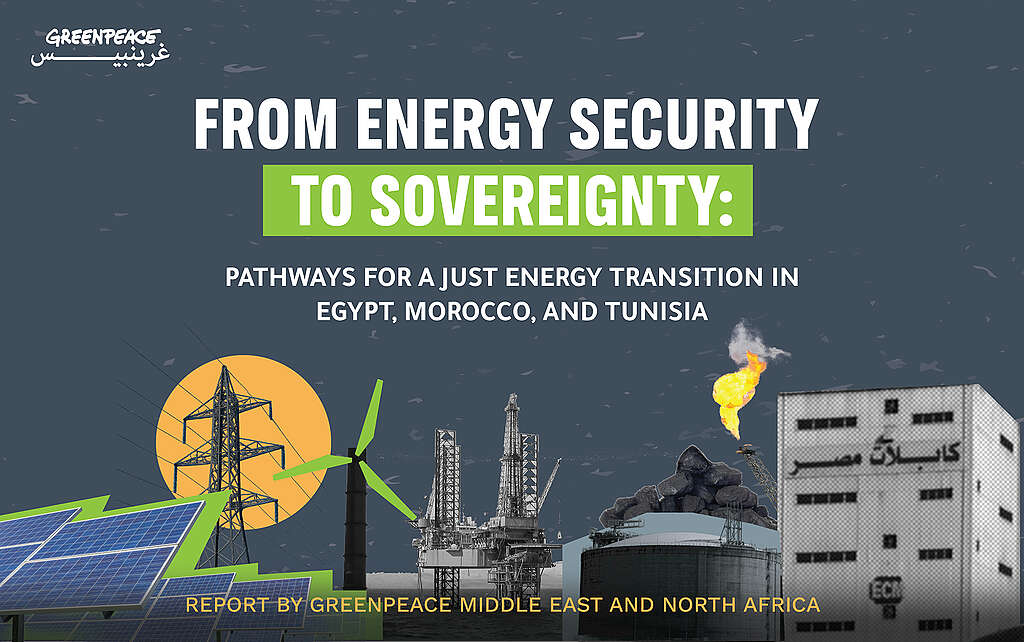
Greenpeace MENA warns in a report
With out reform, North Africa’s power transition might favor buyers over communities
More Read

Learn The Report